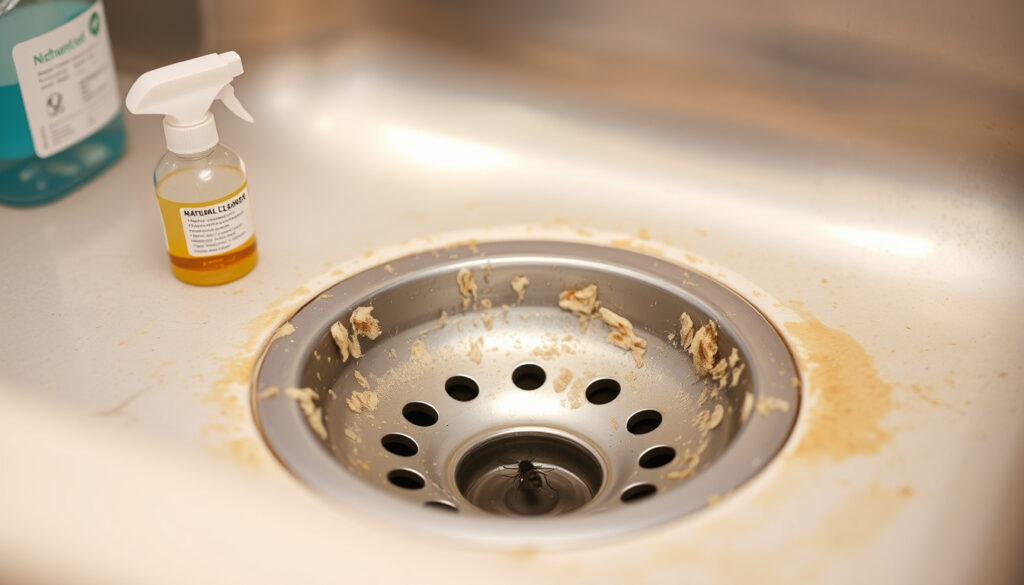
How to Get Rid of Drain Flies Permanently
There’s something unsettling about tiny flies swarming out of your sink drain every time you turn on the faucet. Drain flies are stubborn because they don’t just live in the pipe—they breed in the slimy biofilm coating the inside walls.
Adult lifespan: 2 to 3 weeks · Egg to adult: 7 to 28 days · Breeding habitat: organic sludge in pipes · Wing span: about ⅛ inch
Quick snapshot
- Drain flies breed in the gelatinous organic film inside pipes (Ohio State CFAES Knowledge Hub)
- Removing the biofilm is required for permanent control (University of Arkansas Extension)
- Exact proportion of infestations from toilets vs. sinks
- Field efficacy of essential oil repellents (lab data only available)
- Treatment must continue for at least 3 weeks to break the life cycle (University of Arkansas Extension)
- Identify all breeding drains using a cup or tape trap
- Apply enzyme cleaner weekly for 3–4 weeks
The science behind drain fly control comes down to one number: 3 weeks. That’s how long it takes to break the egg-to-adult cycle if the breeding film is removed.
| Fact | Details |
|---|---|
| Scientific name | Psychodidae family |
| Adult lifespan | 2 to 3 weeks |
| Egg to adult time | 7 to 28 days |
| Breeding medium | moist organic sludge in pipes |
| Health risk | not harmful to humans but can indicate unsanitary conditions |
How to permanently get rid of drain flies?
Clean the drain pipe with a stiff brush and enzyme cleaner
- Use a long-handled drain brush or a brush-tipped snake to physically scrape the gelatinous biofilm off the pipe walls (Ohio State CFAES Knowledge Hub)
- Follow with an enzyme-based drain cleaner designed to digest organic sludge over multiple applications
- If the trap is clogged, removing it improves access for cleaning
Pour boiling water or a vinegar-baking soda mixture weekly
- Boiling water kills larvae and eggs on contact, but does not remove the biofilm (State Industrial (commercial facility guidance))
- A baking soda and vinegar treatment, followed by hot water, helps break up surface organic material (Lowe’s)
Use a commercial drain gel or foaming cleaner to break down sludge
- Some products market biological surfactants that dissolve biofilm for a durable fix (Southland Organics)
- Foaming cleaners suffocate adult flies and reach deeper into pipes than liquid alone
How to get rid of drain flies in toilet and shower
- Toilets: the breeding site is inside the tank, not the bowl. Remove the tank lid and scrub the inside and overflow tube with a stiff brush. Pour enzyme cleaner into the tank and flush after 15 minutes.
- Shower drains: remove the drain cover and physically remove hair and soap scum. Apply an enzyme cleaner overnight. Repeat weekly for 3 weeks.
- All drains in a room must be treated to prevent reinfestation. Seal unused drains with tape or a plug.
Every method that only kills adults fails. The biofilm is the real target, and physical scrubbing combined with an enzyme repeat treatment is the only approach backed by university extension research.
The implication: consistency and thoroughness are the keys to permanent drain fly control.
Why do I suddenly have so many drain flies?
Warm weather accelerates egg-to-adult cycle
- Higher temperatures reduce the egg-to-adult time from up to 28 days down to as few as 7 days
- A dry spell followed by rain can trigger emergence in outdoor drains
Leaky pipes or slow drains create moist breeding sites
- Slow drains indicate accumulating organic material and should be addressed quickly
- Leaks under sinks provide the moisture and nutrients adult flies need to lay eggs
Recent changes in water usage or plumbing repairs can disturb hidden colonies
- If you’ve been away for a week, stagnant water in unused drains becomes prime breeding ground
- Plumbing work can flush larvae and adults out of hidden spots like the toilet overflow tube
A sudden swarm rarely means a new problem; it means an existing colony found a way to emerge. The breeding site was already there—something changed the moisture or temperature and triggered mass emergence.
What this means: the infestation has been building for weeks; you just noticed the adults.
What can I pour down the drain to get rid of flies?
Boiling water kills larvae on contact
- Pouring a full kettle down each drain kills all life stages it reaches
- Effect is temporary; biofilm remains and new eggs will be laid
Baking soda and vinegar creates a foaming reaction that dislodges film
- Combine ½ cup baking soda with ½ cup vinegar, wait 15 minutes, then flush with boiling water
- Works best after mechanical scrubbing has loosened the sludge
Diluted bleach disinfects but requires caution
- Mix 1 cup bleach per gallon of water; pour slowly and avoid splashing
- Bleach can corrode metal pipes over time and is not recommended for septic systems (University of Arkansas Extension)
“Hot water provides only short-term relief if the pipe isn’t scrubbed first. The biofilm acts like a protective shield for larvae and eggs.”
— British Pest Control Association (BPCA) technical officer
The pattern: liquid-only treatments are temporary; the biofilm must be physically removed.
What smells do drain flies hate?
Strong scents like eucalyptus, peppermint, and lavender can deter adults
- Essential oils may reduce adult landing on treated surfaces, but do not eliminate larvae in the drain
- No field trials confirm practical repellency for drain fly infestations; lab data only
Vinegar and citrus-based cleaners disrupt the organic layer they feed on
- The acidity breaks down part of the biofilm, but enzyme treatments are more thorough
Scented drain treatments only repel; they do not kill larvae
- Scent masking is temporary—once the smell fades, adults return
- Pair scent treatments with physical cleaning for any lasting effect
The catch: scent-based approaches are cosmetic at best; they don’t address the breeding source.
What instantly kills drain flies?
Boiling water kills adults, larvae, and eggs on direct contact
- Instant kill—but only for the portion of the population that gets hit
- Eggs deep in the biofilm may survive if water doesn’t reach them
Foaming drain cleaners suffocate adults and dissolve biofilm
- Foam expands into traps and overflow holes, reaching hidden pockets
- Some enzyme foams continue working for hours after application
Flying insect spray (pyrethrin-based) can kill visible flies in the air
- Helpful for immediate relief but does nothing to the source
- No insecticides are registered for use inside drains or sewer systems
“We recommend periodic cleaning with foaming agents to dissolve the organic matter where flies breed. That, combined with a stiff brush, is what works.”
— University of Arkansas Extension entomologist
The implication: instant-kill methods are only useful as a supplement to source removal.
Confirmed facts
- Removing the biofilm eliminates the infestation source (Ohio State CFAES Knowledge Hub)
- Enzyme cleaners are more effective than bleach for long-term control (Ohio State CFAES Knowledge Hub)
- Treatment must continue for at least 3 weeks (University of Arkansas Extension)
What’s unclear
- Exact proportion of infestations originating from toilets vs. sinks
- Efficacy of essential oil repellents in real-world conditions (lab data only)
Do drain flies eventually go away?
Without intervention, no. Adult drain flies die naturally in 2–3 weeks, but the biofilm continues producing new generations every 7–28 days. Seasonal drying may slow activity but won’t eliminate the colony. University of Arkansas Extension emphasizes that indoor populations rely entirely on plumbing biofilm—remove that, and the flies disappear.
reddit.com, reddit.com, greendrains.com, janitorialsuperstore.com, homedepot.com, instagram.com, facebook.com
Frequently asked questions
How do I know if I have drain flies or fruit flies?
Drain flies have fuzzy, moth-like wings and are smaller (⅛ inch). Fruit flies are brown with red eyes and hover near produce, not drains. The easiest test: place a clear cup over the drain overnight; if flies collect inside the cup, they’re drain flies.
Can drain flies live in garbage disposals?
Yes. Food debris and moisture in disposals create ideal breeding conditions. Run the disposal with ice and citrus peels to clean it, then treat with an enzyme cleaner.
Will a drain fly trap alone solve the problem?
Sticky traps and UV-light traps capture some adults but do not eliminate an infestation. They are monitoring tools, not solutions.
Should I call an exterminator for drain flies?
If you’ve scrubbed all drains, applied enzyme cleaner for 3 weeks, and flies persist, an exterminator can inspect hidden sources like sewer lines or crawl spaces. Most DIY cases succeed with persistence.
Can drain flies survive in dry drains?
No. Larvae require moisture. If you dry out a drain completely and keep it dry for 2–3 weeks, any larvae present will die. That’s why sealing unused drains with tape or a plug is effective.
How often should I clean drains to prevent drain flies?
Once a month pour boiling water down each drain and run an enzyme cleaner quarterly. In humid climates, increase to monthly enzyme treatments.
The pattern: consistent maintenance is the only long-term strategy.
For readers dealing with other household maintenance issues, our guides on cleaning services near me and HVAC repair costs offer concrete pricing and DIY advice.
More related posts
 Where is Bora Bora? Location, Country, and Travel Guide
 How to Make Chili – Stovetop and Slow Cooker Recipe
 T-Mobile Plans: Compare Pricing, Features & Roaming
 Isabel May Movies and TV Shows: Full Filmography List
 Duplex for Sale Near Me: Buyer’s Guide & Trends 2026
 Texans vs Patriots Match Player Stats: 28-16 Patriots Win
 Guadalupe Mountains National Park: Guide to Hikes & Peaks
 Convert PDF to Word: Free Online Converters Compared
