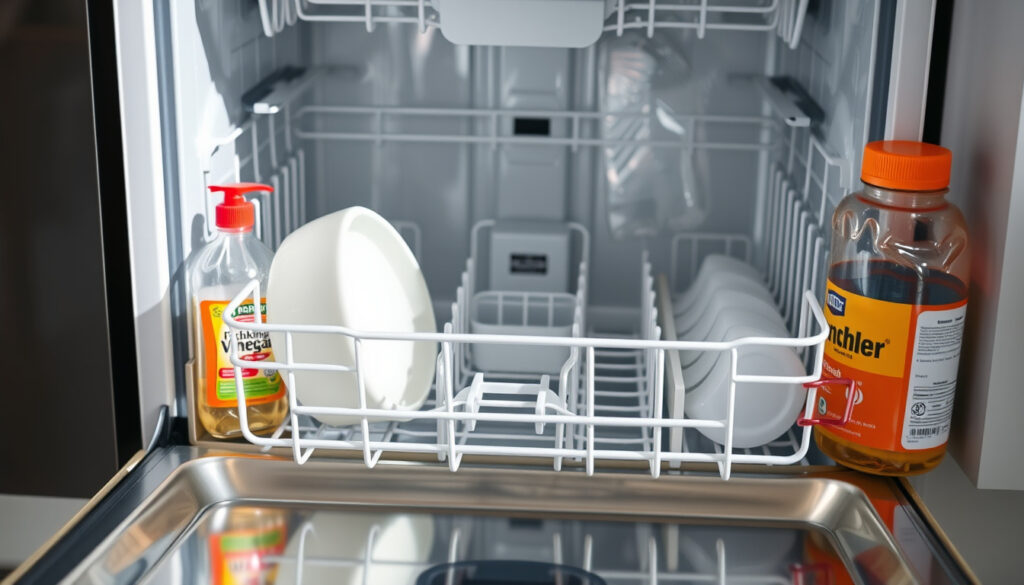
How to Clean a Dishwasher the Right Way (Step-by-Step)
You load the dishwasher, press start, and expect sparkling dishes. But when the cycle finishes, you open it to find grime still clinging to plates and a musty smell wafting out. That’s a sign your dishwasher needs cleaning itself, and the method you choose matters more than most guides admit—especially with vinegar.
Dirty filter cause of poor cleaning: up to 90% of service calls ·
Vinegar on rubber seals: can degrade them; limit to every 3 months ·
Most common mistake: overloading, which reduces water flow ·
Lifespan with regular cleaning: 10-12 years vs. 7-8 years without
Quick snapshot
- Place 1 cup white vinegar in a dishwasher-safe bowl on top rack (KitchenAid appliance guide)
- Run a hot water cycle (KitchenAid appliance guide)
- Follow with a rinse cycle (KitchenAid appliance guide)
- Sprinkle 1 cup baking soda on bottom of dishwasher (Architectural Digest cleaning guide)
- Run a short hot cycle (Bosch maintenance manual)
- Wipe down interior after cycle (Bosch maintenance manual)
- Place tablet in detergent compartment (Affresh cleaner instructions)
- Run a heavy-duty cycle (Affresh cleaner instructions)
- No need to add detergent (Affresh cleaner instructions)
- Remove filter assembly (KitchenAid filter guide)
- Rinse under running water (KitchenAid filter guide)
- Scrub with a soft brush (KitchenAid filter guide)
- Reinstall securely (KitchenAid filter guide)
Maintenance tasks vary in frequency, as shown in the table below.
| Maintenance Task | Recommended Frequency |
|---|---|
| Filter cleaning | Monthly (Consumer Reports appliance expert) |
| Vinegar cleaning cycle | Every 3 months to avoid seal damage (HomeMadeSimple care guide) |
| Deep clean with commercial cleaner | Every 3-6 months (Bosch maintenance manual) |
| Spray arm inspection | Every 6 months |
| Door gasket wipe | Weekly |
What is the best way to clean the inside of a dishwasher?
Manufacturers including GE Appliances (appliance manufacturer) and KitchenAid (appliance manufacturer) agree on a core workflow: remove debris, clean the filter, wipe seals, and run a cleaning cycle. The order matters—skip the filter and the rest is wasted effort.
- Remove and clean the filter
- Wipe the door gasket and seals
- Run a hot cycle with a cleaning agent
- Dry the interior
Remove and clean the filter
- Locate the filter at the bottom center of the dishwasher under the spray arm (KitchenAid maintenance guide)
- Unlock and remove it by turning clockwise or counterclockwise (Consumer Reports cleaning advice)
- Wash with warm, soapy water and scrub with a soft toothbrush (Architectural Digest home guide)
- Soak in warm water and white vinegar for 30 minutes if grime persists (Architectural Digest home guide)
- Rinse and lock back into place
Wipe the door gasket and seals
Use a damp microfiber cloth to wipe the rubber gasket around the door. HomeMadeSimple (cleaning advice blog) warns that vinegar can dry out rubber parts, so stick to mild soap and water for this step.
Run a hot cycle with a cleaning agent
For light maintenance, KitchenAid recommends 2 cups of white vinegar in a dishwasher-safe glass on the bottom rack, running a complete regular cycle with an air-dry option. For heavy grease and limescale, commercial tablets like Affresh (dishwasher cleaner brand) or Finish (dishwashing brand) deliver stronger results.
“Consumer Reports notes that some experts recommend cleaning a removable dishwasher filter once a week, or twice a month if the dishwasher is used infrequently.”
Dry the interior
Prop the door open after the cycle to let moisture escape. Stale standing water inside is the fastest route to that sour smell you were trying to eliminate.
Vinegar handles limescale but not grease. If your water is hard and your dishes are greasy, vinegar alone won’t solve either problem—you need a dual approach: descaler for minerals, commercial cleaner for fat.
The implication: skipping the filter makes all other efforts ineffective. Prioritize filter cleaning for best results.
How do I deep clean my dishwasher?
A deep clean every 3–6 months catches what monthly maintenance misses: spray arm clogs, mineral deposits on heating elements, and grime in the sump area.
- Empty and inspect the dishwasher
- Remove and soak the filter in warm soapy water
- Clean the spray arms with a toothpick or brush
- Use a commercial dishwasher cleaner or vinegar and baking soda combo
- Wipe all surfaces and run a final rinse cycle
Empty and inspect the dishwasher
- Remove all dishes, racks (if possible), and the silverware basket
- Check the bottom for food scraps and wipe debris with a damp cloth (GE Appliances cleaning guide)
- Inspect the spray arms for clogged holes
Remove and soak the filter in warm soapy water
Consumer Reports (independent product testing organization) says some experts recommend cleaning a removable filter once a week, or twice a month if the dishwasher is used infrequently. For a deep clean, soak it in warm water and white vinegar for 30 minutes after scrubbing.
Clean the spray arms with a toothpick or brush
Remove the spray arms (check your manual for the release mechanism) and use a toothpick to clear each hole. Bosch maintenance instructions recommend running water through the arms to flush debris from inside after clearing the holes.
Use a commercial dishwasher cleaner or vinegar and baking soda combo
Bosch (appliance manufacturer) advises starting the longest, hottest empty wash cycle and adding a box of descaler after 30 minutes. For a DIY alternative, sprinkle 1 cup baking soda on the bottom and run a short hot cycle after the vinegar step.
Wipe all surfaces and run a final rinse cycle
Wipe down the interior walls, door, and rubber gasket with a damp cloth. Run a rinse cycle to clear any remaining residue. The result: a machine that smells neutral and performs like it did on day one.
Ignoring the spray arms during a deep clean means water jets stay 30–40% less effective. That patch of crust on your lasagna pan isn’t the detergent’s fault—it’s the clogged arm above it.
The pattern: deep cleaning every 3–6 months prevents performance degradation that monthly maintenance alone cannot fix.
Can I pour vinegar in my dishwasher to clean it?
Yes, but with specific constraints. Vinegar is effective against limescale but ineffective against grease, and it can damage rubber components if overused.
How vinegar works in a dishwasher
The acetic acid in white vinegar dissolves calcium and mineral deposits. KitchenAid (appliance manufacturer) recommends 2 cups of white vinegar in a dishwasher-safe glass on the bottom rack, running a full cycle with an air-dry setting. Branch Basics (cleaning brand) suggests placing the cup on the top rack instead so the vinegar stays contained.
When to use vinegar (and when not to)
- Use it: for light limescale buildup, monthly maintenance, and deodorizing
- Avoid it: for heavy grease, after using bleach (mixing creates toxic chlorine gas), or more than once every 3 months
“HomeMadeSimple warns that vinegar may dry out rubber parts, causing cracking and leaks. Whirlpool advises against regular vinegar use for this reason.”
Whirlpool (appliance manufacturer) advises against regular vinegar use due to seal damage risk.
Vinegar vs. commercial cleaners
Comparing the two methods reveals key trade-offs in cost, effectiveness, and safety.
| Factor | Vinegar | Commercial cleaner tablet |
|---|---|---|
| Removes limescale | Yes, effective | Yes, effective |
| Removes grease | No | Yes (Affresh cleaner) |
| Seal safety | Risk of damage with frequent use (HomeMadeSimple seal warning) | Formulated to be safe |
| Cost per clean | ~$0.10 | ~$1.00-$1.50 |
| Manufacturer recommended? | Some recommend limiting use (KitchenAid) | Yes, most major brands (Bosch, Finish) |
The implication: vinegar works as a maintenance tool, not a deep-cleaning solution. If you’re fighting hard water scale, a descaler tablet is the safer bet for your machine’s longevity.
Steps to use vinegar safely
- Place 1-2 cups white vinegar in a dishwasher-safe cup on the top rack (Branch Basics placement guide)
- Run a complete hot cycle with air-dry setting (KitchenAid cycle advice)
- Follow with a rinse cycle to remove vinegar residue
- Limit this method to every 3 months
The catch: vinegar is effective for maintenance but not for deep cleaning. Use commercial tablets for heavy grease and scale.
What are common dishwasher cleaning mistakes?
Most dishwasher problems trace back to a handful of avoidable errors. Fix these, and your machine will likely perform better without any product changes.
Overloading the dishwasher
When dishes are packed too tightly, water can’t reach every surface. Consumer Reports (independent testing organization) has documented that overloading reduces cleaning effectiveness because spray arms can’t rotate freely and water jets are blocked.
Using too much detergent
Extra detergent doesn’t mean cleaner dishes. Excess suds leave a white film on glassware and can cause the dishwasher to leak. Use only the amount recommended by the detergent manufacturer for your water hardness level.
Skipping filter cleaning
A dirty filter is the top cause of poor cleaning performance. Consumer Reports warns that neglecting the filter can clog the dishwasher and potentially lead to a flood at the bottom of the machine. Finish (dishwashing brand) recommends removing and rinsing the filter regularly according to your dishwasher’s instructions.
Using the wrong type of detergent
Regular dish soap creates massive foam that can destroy the machine. Use only dishwasher detergent—pods, powder, or gel designed for automatic dishwashers.
Not scraping food before loading
Pre-rinsing isn’t necessary with modern dishwashers, but large food scraps should be scraped into the trash. Bits of food that stay on dishes end up in the filter, accelerating the clog cycle.
Using dish soap even once can cause a foam overflow that ruins flooring. The cost of a dishwasher repair from a suds-related leak averages $200–$500—while a jug of proper detergent costs $6.
What this means: avoiding these mistakes is cheap and easy. Prioritize proper loading, detergent, and filter care to keep your dishwasher running efficiently.
How do I clean the dishwasher filter?
The filter is the single most important component for cleaning performance, and it’s also the most neglected. KitchenAid (appliance manufacturer) provides a straightforward process:
Locate the filter (usually bottom center)
Open the dishwasher and remove the bottom rack. The filter assembly is at the center or back of the floor. Some models have a coarse filter on top and a fine filter underneath.
Remove and rinse under running water
Consumer Reports (independent testing organization) explains: turn the filter clockwise or counterclockwise depending on the model, lift it out, and rinse it under warm running water. A sponge and some dish soap handle most of the grime.
Scrub with a soft brush if necessary
For stubborn particles, Architectural Digest (home publication) recommends using a soft-bristle toothbrush, water, white vinegar, and baking soda. After rinsing and brushing, soak the filter in warm water and white vinegar for at least 30 minutes.
Reinstall properly
Lock the filter back into place by aligning it and turning until it clicks. A loose filter allows food particles to recirculate and settle on your dishes.
Cleaning the filter once a month takes 5 minutes. Skipping it for six months means you’re essentially washing dishes in recycled food water. The difference in cleaning performance is night and day.
The pattern: a clean filter is the foundation of dishwasher performance. Monthly cleaning prevents 90% of service calls.
Related reading: How to Get Rid of Drain Flies Permanently · HVAC Repair Near Me: Costs, Common Problems & DIY Tips
Frequently asked questions
How often should I run a cleaning cycle on my dishwasher?
Run a maintenance cycle with vinegar every 3 months and a deep clean with a commercial cleaner every 3-6 months. The filter should be cleaned monthly, and door seals wiped weekly.
Is it safe to use bleach in a dishwasher?
No. Most manufacturers, including Whirlpool (appliance manufacturer), advise against bleach because it can damage stainless steel interiors and rubber seals. Bleach also produces toxic fumes if it mixes with other cleaning agents.
Can I clean my dishwasher with lemon juice?
Lemon juice can deodorize and remove light limescale, but the citric acid is weaker than commercial descalers. It’s safe to use occasionally, but don’t rely on it for deep cleaning—the acidity can dull stainless steel over time.
What is the best dishwasher cleaner tablet?
Affresh (appliance cleaner brand) and Finish (dishwashing brand) are the most widely recommended. Both remove limescale, grease, and odors without damaging machine components.
Why does my dishwasher smell even after cleaning?
Check the filter first—food trapped there is the most common cause of odors. If the filter is clean, run a hot cycle with vinegar to clear the drain hose and sump area. Stale water in the drain line is often the hidden culprit.
Do I need to clean the dishwasher spray arms?
Yes. Food particles and mineral deposits can clog the spray arm holes. Use a toothpick to clear them every 6 months. Bosch (appliance manufacturer) recommends removing spray arms and flushing them with water during deep cleaning.
How do I remove hard water stains from my dishwasher?
Run a cycle with a commercial descaler designed for dishwashers, or place 2 cups of white vinegar on the top rack and run a hot cycle. For stubborn stains, use a soft cloth dipped in vinegar to wipe interior surfaces.
By following these steps, your dishwasher will perform better and last longer. Consumer Reports notes that regular filter cleaning alone can extend dishwasher life by 2–3 years.
More related posts
 What Is an Adverb? Definition, Types, Examples
 How to Make Sourdough Bread – Step-by-Step Beginner Guide
 How to Connect AirPods to iPhone, Android & Windows
 A Series of Unfortunate Events: Banned, LGBTQ+ & Ending
 SAVE Plan Student Loans: How to Transition After Ruling
 How to Connect Xbox Controller to PC: USB, Bluetooth & Fixes
 United States Department of Justice: Structure and Key Agencies
 How to Enter Your Microsoft Link Code: Complete Guide
