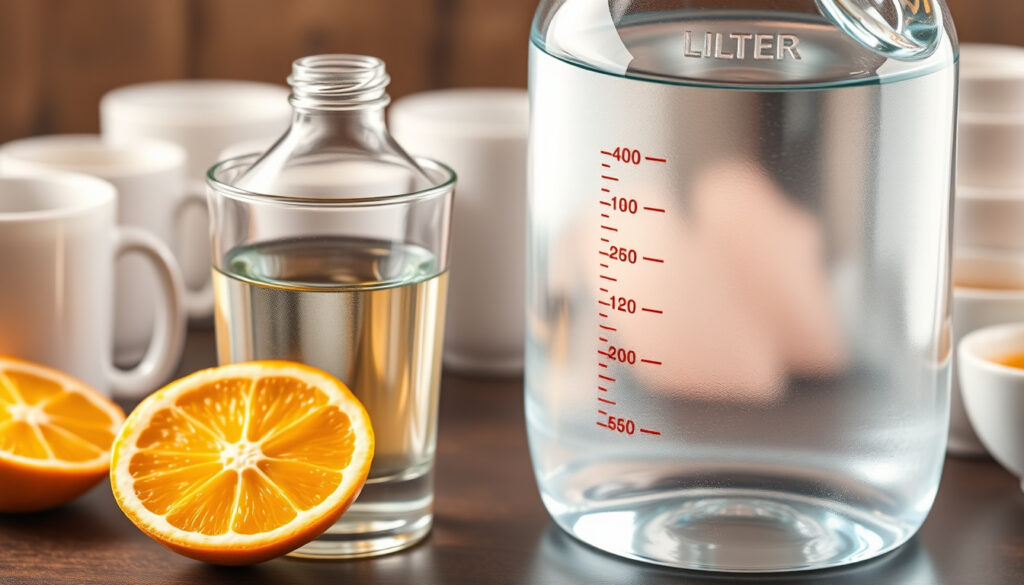
1 Liter to Oz: Conversion, Cups, Bottles, and Health
If you’ve ever looked at a 32 oz water bottle and assumed it held a liter, you’re not alone. It actually falls 1.8 ounces short, and the gap matters once you see the daily targets: about 3.7 liters for adult men and 2.7 liters for adult women, according to the National Academies of Sciences, Engineering, and Medicine (health research body).
1 liter to US fluid ounces: 33.814 fl oz · 1 liter to US cups: 4.227 cups · 1 liter to 8 oz glasses: 4.23 glasses · 1 liter to 16 oz bottles: 2.11 bottles · 64 US fluid ounces: 0.5 US gallon
Quick snapshot
- 1 liter = 33.814 US fluid ounces = 1,000 mL, and 1 US fluid ounce ≈ 29.57 mL (NIST (U.S. measurement authority))
- The exact list of “six dehydration signs” is not standardized by a single authority.
- Daily water needs shift with age, activity, climate, and medical status.
- Morning water on an empty stomach has no universally proven unique benefit.
- Adequate total water for a day is about 3.7 liters for men 19–30 and 2.7 liters for women 19–30 (National Academies of Sciences, Engineering, and Medicine (health research body)).
- A single liter covers about a quarter of a man’s daily total and more than a third of a woman’s. (National Academies of Sciences, Engineering, and Medicine (health research body))
- When a label says “32 oz” but you’re logging liters, add 1.8 oz per bottle.
- For a 64 oz daily goal, plan for 0.5 US gallon, not 1 liter.
Six numbers capture the whole liter-to-ounce relationship, and each one follows the U.S. customary definitions maintained by NIST (U.S. measurement authority).
| Measurement | Equivalent |
|---|---|
| 1 liter | 33.814 US fluid ounces |
| 1 liter | 1,000 milliliters |
| 1 liter | 4.227 US cups |
| 1 US gallon | 3.785 liters |
| 32 fluid ounces | 0.946 liters |
| 64 fluid ounces | 0.5 US gallon |
How much is 1 litre of water?
One liter is exactly 1,000 milliliters. In U.S. fluid ounces, that’s 33.814 oz; in Imperial fluid ounces, it’s about 35.195 oz. The difference exists because U.S. and Imperial ounces are not the same size.
- 1 liter = 1,000 milliliters (metric base unit)
- 1 liter = 33.814 US fluid ounces ≈ 35.195 Imperial fluid ounces
- 1 US fluid ounce ≈ 29.57 milliliters
The “32 oz bottle = 1 liter” shortcut under-counts by 1.8 oz per bottle. After two bottles, your log is already 3.6 oz behind reality.
The pattern: the rounded ounce number many bottles use tries to make the metric system look neater than it is on a U.S. label.
How many 8 oz glasses of water is a liter?
It takes 4.23 standard 8 oz glasses to fill a liter. Four full glasses is 32 oz, which is close but not exact.
- 8 US fluid ounces = 236.588 mL
- 1 liter ≈ 4.23 8-ounce glasses
- 16 oz bottle = 473.18 mL, so 1 liter ≈ 2.11 bottles
- 500 mL bottle = 16.9 oz, so 2 bottles = 1 liter
If you track by 16 oz bottles, the usual “two bottles” shortcut is 32 oz — still short by 1.8 oz. If you’re measuring water for cooking, the same offset can throw off a recipe; our guide on how to make rice treats water measurement as part of the method.
What this means: when the goal says “8 glasses,” that’s about 1.9 liters, not a neat 2.
Does 1 liter equal 4 cups?
Only if those cups are metric. A U.S. customary cup is 236.588 mL, so a liter is 4.2268 cups.
- 1 US cup = 236.588 mL
- 1 liter = 4.2268 US cups
- 1 metric cup = 250 mL, so 4 metric cups = exactly 1 liter
- 4 US cups = 946.35 mL = about 0.946 liters
Recipes that round a liter down to 4 U.S. cups lose about 54 mL of liquid — enough to change how rice or dough absorbs water.
The takeaway: use 4.23 U.S. cups, not 4, unless the recipe was written with 250 mL metric cups.
Is 32 oz the same as 1 liter?
No. 32 US fluid ounces equals 0.946 liters. One liter is 33.814 oz, so a 32 oz container falls 1.814 ounces short.
- 32 fl oz = 0.946 liters
- 1 liter = 33.814 US fl oz
- 64 fl oz = 1.893 liters (not 1 liter)
- 64 fl oz = 0.5 US gallon
Why this matters: five “liter-sized” bottles that actually hold 32 oz leave you 9 oz short of five true liters — nearly a full extra glass of water.
The pattern: round numbers sell bottles, but they don’t re-write the conversion.
Is 1 liter the same as 1 gallon?
No. A U.S. gallon is 128 fluid ounces, which equals 3.785 liters. A liter is about 0.264 U.S. gallons.
- 1 US gallon = 128 US fl oz
- 1 US gallon = 3.785 liters
- 1 liter = 0.264 US gallons
- 64 US fl oz = 0.5 US gallon (half gallon, not 1 liter)
The catch: if you fill a half-gallon jug expecting a liter, you’re carrying almost twice as much water as the label implies.
What are the 6 signs you are not drinking enough water?
There isn’t one official list with exactly six signs, but the markers that appear most consistently are thirst, dark yellow urine, less frequent urination, dry mouth, fatigue, and dizziness.
- Thirst
- Dark yellow urine
- Less frequent urination
- Dry mouth
- Fatigue
- Dizziness
For a daily target, the National Academies of Sciences, Engineering, and Medicine (health research body) set adequate total water intake at about 3.7 liters per day for adult men and 2.7 liters per day for adult women, including water in food. If you finish one 16 oz bottle, that’s roughly 0.47 liters — not enough to judge your whole day.
- Is it okay to drink 1 litre of water a day? For most adults, yes, but it’s below the total-water target. One liter from beverages is a normal starting point, not a full day’s need.
- How much water should I drink daily to help my kidneys? A practical target is to keep urine light yellow; daily needs vary with climate, activity, and health status.
- What happens if I drink water on an empty stomach in the morning? It rehydrates you after overnight losses. There is no universal evidence of a special empty-stomach benefit beyond normal hydration.
“8 glasses a day” converts to about 1.9 liters, not 2. If you aim for the rounded number, you’re short by roughly 100 mL — small, but real over a week.
The practical pattern: dehydration signs are a guide, not a precise checklist; the liter numbers matter because they help you estimate fluid across a whole day.
Three systems, one liter: the same volume changes appearance when you switch from U.S. to Imperial to metric fluid measures, and the values below follow NIST’s Handbook 133 conversion tables (U.S. measurement authority).
| Quantity | U.S. customary | Imperial | Metric |
|---|---|---|---|
| 1 liter | 33.814 US fl oz | 35.195 Imperial fl oz | 1,000 mL |
| 1 fluid ounce | 1 US fl oz | 1.041 Imperial fl oz | 29.5735 mL |
| 1 gallon | 128 US fl oz (US gallon) | 160 Imperial fl oz (Imperial gallon) | 3.785 L (US gallon) |
The pattern: “gallon” and “ounce” are not universal units. If a label doesn’t say U.S. or Imperial, the number can be off by about 4 percent.
Confirmed facts
- 1 liter = 33.814 US fluid ounces
- 1 US gallon = 128 fluid ounces
- 1 US cup = 236.588 mL
- 64 US fluid ounces = half US gallon
What’s unclear
- No single authority standardizes a list of exactly six dehydration signs
- Daily water needs vary with age, activity, climate, and medical status
- Empty-stomach water timing has no universally proven unique benefit
What the experts say: the same numbers, in context.
“For men ages 19 through 30, the adequate total water intake is about 3.7 liters per day; for women ages 19 through 30, it is about 2.7 liters per day, with food moisture counted as part of total water.”
National Academies of Sciences, Engineering, and Medicine (health research body)
“A liter is 33.814 U.S. fluid ounces, or about 35.195 Imperial fluid ounces — two different ounces, two different conversions.”
National Institute of Standards and Technology (U.S. measurement authority)
“Practical hydration targets are daily totals, and they include water in food — a single bottle or glass is just one step toward the full number.”
National Academies of Sciences, Engineering, and Medicine (health research body)
The takeaway: The conversion itself is simple; the trap is rounding. A liter is 33.8 US fluid ounces, not 32, and a gallon is 3.785 liters, not 4. For anyone tracking daily water in ounces, the choice is clear: treat a liter as 33.8 oz, not 32 oz, or every bottle you log will under-report by about 1.8 ounces.
nist.gov, nationalacademies.org, nist.gov, rsfh.com, dartmouth-health.org
Frequently asked questions
How many ounces are in a 2-liter bottle?
A 2-liter bottle holds 67.6 US fluid ounces. That’s the kind of quantity you’ll see on soda and mixer labels; for more on how bottle sizes are sold and delivered, see our guide to Alcohol Delivery Near Me: Safe Options, Rules and Limits (2025).
What is 1 liter in imperial fluid ounces?
1 liter is about 35.195 Imperial fluid ounces.
Is 1 liter the same as a quart?
No. A U.S. quart is 32 fl oz, or 0.946 liters; a liter is 33.814 fl oz, about 1.057 quarts.
How many US fluid ounces are in one gallon?
There are 128 US fluid ounces in one US gallon.
What is the difference between US and imperial fluid ounces?
A US fluid ounce is about 29.5735 mL and equals about 1.041 Imperial fluid ounces. Imperial fluid ounces are slightly smaller, which is why a liter looks bigger in Imperial ounces.
How many milliliters are in a fluid ounce?
One US fluid ounce is about 29.5735 milliliters.
More related posts
 What Is a Condo? Definition, Differences, Pros and Cons
 Where to Watch Seahawks vs 49ers: FOX TV, NFL+ Stream
 Best Internet Providers Near Me in Ireland: Compare 2025
 US Dollar to Euro: Live Rate & Why It’s Falling
 Isabel May Movies and TV Shows: Full Filmography List
 How Tall Is Patrick Mahomes? Height, Stats & Facts
 Food Trucks Near Me in Ireland: Locations, Costs & Apps
 Gordon Ramsay Net Worth 2026: How Much Is He Really Worth
