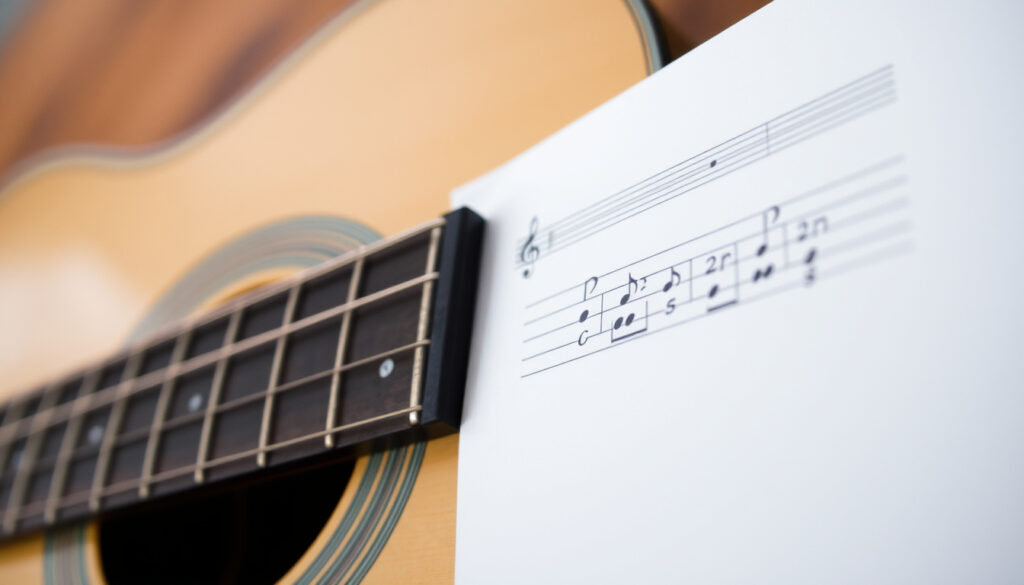
How to Read Guitar Tabs: A Beginner’s Guide to Tablature
Anyone who’s picked up a guitar and searched for a song online has seen them: six lines with numbers scattered across them. Guitar tablature is the most direct way to turn a screen into sound without learning standard musical notation. This guide breaks down exactly how those lines, numbers, and symbols translate into music you can play—with concrete examples and trusted sources at every step.
Number of strings: 6 ·
Lines in tab: 6 (each string) ·
Numbers indicate: Fret to press ·
Common symbols: h, p, b, /, ~, x, pm ·
Standard tuning: EADGBe (low to high)
Quick snapshot
- Six horizontal lines represent the six strings — top line is the high E (JustinGuitar (established guitar educator))
- Numbers indicate which fret to press on a given string (Hal Leonard (music publisher))
- Tabs are read left to right, matching musical time flow (Songsterr (tab database))
- The exact origin of modern guitar tab notation is debated among music historians (Eddie’s Guitars (instrument retailer))
- Rhythm notation in tabs is not standardized across all sources — spacing between numbers can suggest timing but is not reliable (Pickup Music (online guitar lessons))
- Fret numbers have remained the core notation of guitar tab for decades, with symbols for techniques added over time (Hal Leonard (music publisher))
- Standard tuning (EADGBe) is assumed in virtually all modern tab unless marked otherwise (JustinGuitar (established guitar educator))
- Learning to interpret rhythm indicators (stems, beams, animated tabs) unlocks the full potential of tablature (Guitar Tricks Blog (guitar lesson platform))
- Advanced techniques like tapping and harmonics are represented by additional symbols that build on the basic system (Pickup Music (online guitar lessons))
Five key facts define how guitar tab works, and they all stem from a simple principle: numbers on lines.
| Label | Value |
|---|---|
| Number of strings | 6 |
| Lines representation | Each line = a guitar string (top = high E, bottom = low E) |
| Numbers | Fret number to press; 0 = open string |
| Standard tuning | EADGBe (low to high) |
| Common symbols | h, p, b, r, /, \, ~, x, pm |
| Reading direction | Left to right (Songsterr (tab database)) |
Bottom line: The guitar tab system relies on a straightforward mapping of six strings to six lines, with numbers dictating fret positions. This eliminates the need to read standard notation entirely for beginners.
How to Read Guitar Tabs for Beginners
Understanding the Six Lines
- The top line represents the thinnest string (high E), and the bottom line represents the thickest string (low E) (JustinGuitar (established guitar educator)).
- This orientation matches the view of the guitar as you hold it—the high E is physically the closest string to your chin.
The implication: you don’t need any prior music theory to understand which string is which. The lines are the strings.
Reading Numbers on the Lines
- A number on a line tells you which fret to press on that string. 0 means play the string open (no fretting) (Pickup Music (online guitar lessons)).
- Numbers progress left to right in the order you play them (Songsterr (tab database)).
Why this matters: a sequence like 3-0-0 on the high E string means fret the third fret, then play two open notes—simple enough to play by ear.
Placing Your Fingers
- Each finger is typically assigned a fret: index (1st fret), middle (2nd), ring (3rd), pinky (4th). Tabs don’t always show fingerings, but the fret number guides you.
- For multi-digit frets like 12, the two digits are just one note—no special formatting needed (Guitar Tricks Blog (guitar lesson platform)).
Bottom line: Beginners can start playing simple melodies in minutes by matching numbers to fret positions. No rhythmic precision required at first—just accurate fingering.
How to Read Guitar Tab Symbols
Hammer-Ons and Pull-Offs (h and p)
hindicates a hammer-on: pick the first note and then sound a higher note by slamming a finger down without picking again (Guitar Tricks Blog (guitar lesson platform)).pindicates a pull-off: pick the first note, then pull a finger off to sound a lower note (Guitar Tricks Blog (guitar lesson platform)).
The pattern: these two symbols let you play two notes with a single pick stroke—essential for fast licks.
Bends (b) and Releases (r)
bdenotes a bend: push the string sideways after picking to raise the pitch (Guitar Tricks Blog (guitar lesson platform)).rafter a bend indicates release back to the original pitch, though the exact notation can vary across sources (Guitar Tricks Blog (guitar lesson platform)).
The catch: bends are a signature of blues and rock guitar, and reading them accurately transforms a static note into an expressive wail.
Slides (/) and (\)
- A forward slash (
/) means slide up from one fret to a higher one; a backslash (\) means slide down (Pickup Music (online guitar lessons)). - Slides are directional: you pick the first note and slide your finger to the second without picking again.
What this means: slides add fluidity and are common in everything from country to metal.
Vibrato (~) and Palm Mute (pm)
- Tilde (
~) above or next to a note indicates vibrato—a slight wavering of pitch created by rocking the finger (Guitar Tricks Blog (guitar lesson platform)). pmsignifies a palm mute: rest the edge of your picking hand on the strings near the bridge to dampen the sound (Guitar Tricks Blog (guitar lesson platform)).
Mastering symbol reading separates a mechanical player from an expressive one. A bend, a slide, or a palm mute changes the character of a phrase completely—and these symbols are the only way to encode that on paper (or screen).
How to Read Guitar Chords in Tablature
Chord Diagrams vs Tab Chords
- A chord diagram shows a vertical neck with dots on frets; tab chords show numbers stacked vertically on the six lines (Musicmaker (music store resource)).
- Both systems share the same logic: the string order is identical, and numbers indicate frets.
The pattern: chord diagrams are easier for quick reference, but tab chords integrate directly into a song’s note sequence.
Stacked Numbers for Strumming
- When numbers appear one above another on the same vertical column, you play them simultaneously as a chord (Musicmaker (music store resource)).
- Strumming direction may be shown by up/down arrows above the tab or by rhythmic notation between the lines.
The trade-off: chord tabs don’t show fingerings—you need to experiment to find the most comfortable grip, especially for barre chords.
Reading Chord Fingering
- Many tab sites include a chord box diagram near the tab to clarify finger placement. Use both together for best results.
- Open chords (e.g., G major, C major) appear as stacked numbers often including zeros for open strings.
Bottom line: Chord tablature uses the same string-line logic as single-note tab. Stacked numbers = strum. For beginners, pairing tab with chord diagrams accelerates learning by providing a visual of where the fingers go.
How to Read Guitar Tab Numbers and Fret Markings
Single-Number Notation
- A lone number like
5on the A string means press the fifth fret on that string (Hal Leonard (music publisher)). - Numbers go up to the guitar’s highest fret (typically 22 or 24 on modern instruments).
The pattern: every number is unambiguous—it tells you exactly where to put your finger.
Multi-Digit Frets
- Two-digit numbers like
12or15are read as a single note value; the digits are not separate notes (Guitar Tricks Blog (guitar lesson platform)). - Spacing in tab usually aligns the number so that both digits sit together—no hyphen or extra gap needed.
Open Strings (0) and Muted Strings (x)
0means play the string open without pressing any fret (Pickup Music (online guitar lessons)).xindicates a muted or dead note—usually produced by lightly touching the string with a fretting finger without pressing it down, or by resting the picking hand on it (Guitar Tricks Blog (guitar lesson platform)).
Numbers and markings in tab are absolute—they give you the exact fret and string. The only ambiguity arises with rhythm (which numbers don’t encode) and with symbols that have multiple interpretations across different tab sources.
How to Read Guitar Tabs with Rhythm
Standard Tab Rhythm Notation
- Most basic tabs do not include explicit rhythm; spacing between numbers can suggest timing but is not reliable (Pickup Music (online guitar lessons)).
- To know the exact duration of a note, you need either standard notation above the tab or a rhythmic stem system.
Using Spacing and Beams
- Some tablature programs use wider gaps between notes to indicate longer pauses—but this is inconsistent across publishers (Songsterr (tab database)).
- Beams (horizontal lines connecting note stems) appear above or below the tab lines in more sophisticated tab formats to show note durations (eighth notes, sixteenth notes, etc.).
Advanced Rhythm Indicators
- Online tab sites like Songsterr and Ultimate Guitar animate the tab in sync with playback, effectively solving the rhythm problem (Songsterr (tab database)).
- For printed tab, the best approach is to listen to the original recording and use the tab as a fret-position guide rather than a rhythmic blueprint.
Bottom line: Rhythm is the weak link in most guitar tablature. Beginners should rely on audio playback alongside tab until they develop a feel for timing. For advanced players, animated tabs and tab-with-notation hybrids offer the most complete experience.
Step-by-Step Guide to Reading Guitar Tabs
- Identify the strings: Hold the tab so the top line is the thinnest string (high E) and the bottom line is the thickest (low E). Memorize the tuning: EADGBe.
- Find the fret numbers: Look at the numbers on each line. A
0means open string; any other number means press that fret on that string (JustinGuitar (established guitar educator)). - Read left to right: Play the notes in the order they appear. Multiple notes stacked vertically = play them simultaneously as a chord (Musicmaker (music store resource)).
- Decode technique symbols: Look for letters like
h,p,b,/,\,~, andx. Refer to the symbol legend above to understand each. - Determine rhythm: If the tab has stems or beams, use them to gauge note lengths. If not, listen to the song and match the tab notes to what you hear (Pickup Music (online guitar lessons)).
The pattern: this five-step method works for any tab, from a simple melody to a complex solo.
What’s Confirmed and What’s Unclear
Confirmed facts
- Tabs show fret numbers on six horizontal lines representing strings (JustinGuitar).
- Symbols such as h, p, b, and / indicate specific playing techniques (Guitar Tricks Blog).
- Tuning is typically standard (EADGBe) unless specified otherwise (Hal Leonard).
Rumors & unclear points
- The exact origin of modern guitar tab notation is debated (Eddie’s Guitars).
- Rhythm notation in tabs is not standardized across all sources (Pickup Music).
- Some curved or arched line markings may indicate vibrato, but the exact interpretation varies by tab source (YouTube (community lesson)).
- An ‘r’ after a bend often indicates release, but this is not a universal standard (Guitar Tricks Blog).
The trade-off: the strength of guitar tab—its simplicity—is also its weakness. Without standardized rhythm and occasional ambiguous symbols, your ear remains the final judge.
“The top line represents the high E string (the thinnest).” — School of Rock lesson
“Tab is the most accessible way to learn songs quickly.” — JustinGuitar
For the beginner, picking up a guitar and a tab is like receiving a map with all the landmarks labeled. The numbers and symbols remove guesswork, leaving only the joy of playing. For the aspiring guitarist, the choice is clear: learn tab notation, or miss out on the simplest path to playing your favorite songs.
eddiesguitars.com, reddit.com, acousticlife.tv, youtube.com, music2me.com
For a more detailed explanation, you can refer to this comprehensive reading guitar tabs guide that breaks down tab symbols and techniques.
Frequently asked questions
What does ‘h’ mean in guitar tabs?
A hammer-on. You pick the first note and then slam a finger down on a higher fret without picking again (Guitar Tricks Blog).
How do I read a palm mute in tab?
Look for pm above or before a group of notes. It means you rest the edge of your picking hand on the strings near the bridge to dampen them (Guitar Tricks Blog).
What is the difference between guitar tab and sheet music?
Tab tells you which fret to press on which string, but does not encode rhythm. Sheet music (standard notation) shows exact pitch and rhythm, but requires knowledge of note names and durations (Hal Leonard).
How to read a slide in tab?
A forward slash (/) means slide up from one fret to a higher one; a backslash (\) means slide down. You pick the first note and slide your finger to the second (Pickup Music).
How to read vibrato in tab?
Vibrato is usually shown by a tilde (~) above or next to a note. It means you rock your fretting finger to slightly vary the pitch (Guitar Tricks Blog).
What do parentheses indicate in a guitar tab?
Parentheses often indicate a ghost note or a note that is barely audible, or they can show that a note is sustained from a previous bend or slide. The meaning depends on the tab source.
How to read tab for multiple guitars?
Each guitar part is written on its own set of six lines, usually labeled (Guitar 1, Guitar 2). Read each part separately, and note that rhythms may differ between lines.
Related reading
More related posts
 What Is a Speakeasy? History, Code, Modern Bars
 Selena Gomez and Benny Blanco: Relationship Timeline & Wedding
 The Haunting in Connecticut – True Story Behind the Movie
 Limited Edition Stanley Cup: Rarity, Resale Prices & Fakes
 Guadalupe Mountains National Park: Guide to Hikes & Peaks
 John Wick: Chapter 5: Release Date, Cast & Updates
 How to Clean a Dishwasher the Right Way (Step-by-Step)
 Fast and Furious 3 Cast: Tokyo Drift Stars & Roles
