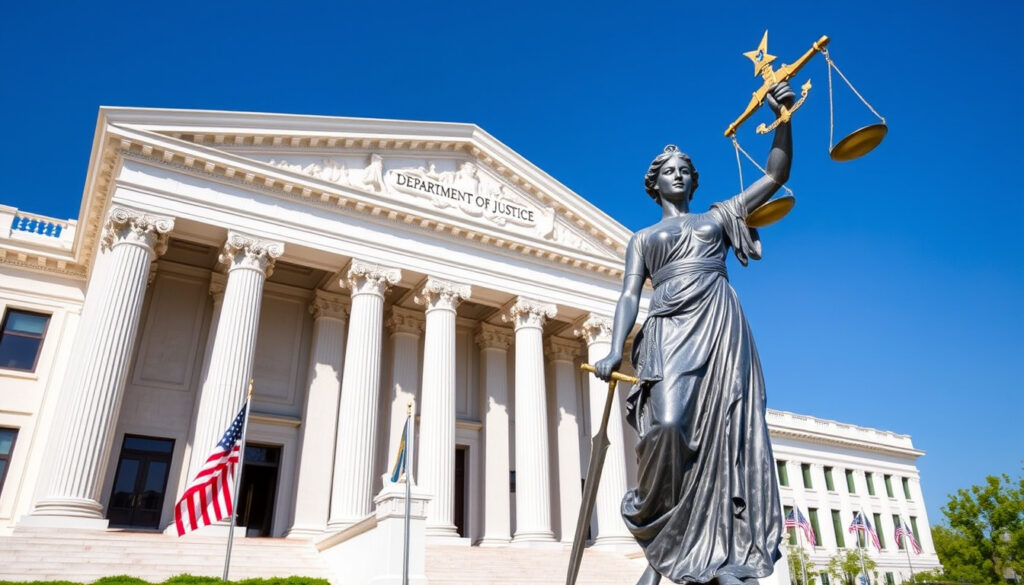
United States Department of Justice: Structure and Key Agencies
Every time the federal government steps into a courtroom or launches a cross-state investigation, the same agency is behind it: the Department of Justice, the country’s top law enforcement body and legal representative for the entire executive branch, with an annual budget of roughly $30 billion and more than 113,000 employees. This guide breaks down what the DOJ actually does, how it differs from the FBI and CIA, and who calls the shots.
Founded: 1870 ·
Annual budget: ~$30 billion ·
Employees: 113,000+ ·
Major components: 40+ divisions, bureaus, and offices
Quick snapshot
- Enforce federal laws (DOJ mission statement)
- Defend the interests of the United States (DOJ mission statement)
- Ensure fair and impartial administration of justice (DOJ mission statement)
- Attorney General (head)
- Deputy Attorney General (head)
- Solicitor General (head)
- Associate Attorney General (head)
- Official website: www.justice.gov
- Phone: 202-514-2000 (www.justice.gov)
- Headquarters: 950 Pennsylvania Avenue NW, Washington, D.C. (www.justice.gov)
Six key numbers sketch the DOJ’s scale: its founding year, headquarters, leadership, workforce, budget, and major enforcement arms.
| Label | Value |
|---|---|
| Established | 1870 |
| Headquarters | 950 Pennsylvania Avenue NW, Washington, D.C. |
| Current Attorney General | Merrick Garland |
| Employees | 113,000+ |
| Annual budget | ~$30 billion (2023) |
| Major law enforcement components | FBI, DEA, ATF, USMS |
What is the Justice Department in the United States?
The Department of Justice (DOJ) is the federal executive department responsible for law enforcement and legal administration. It was created in 1870, making it one of the oldest cabinet-level departments (U.S. Department of Justice – About DOJ). The Attorney General, currently Merrick B. Garland, serves as its head and the nation’s chief law enforcement officer (Justice Department – Attorney General biography).
What is the mission of the DOJ?
“To enforce the law and defend the interests of the United States according to the law; to ensure public safety against threats foreign and domestic; to provide federal leadership in preventing and controlling crime; to seek just punishment for those guilty of unlawful behavior; and to ensure fair and impartial administration of justice for all Americans.”
DOJ Mission Statement (U.S. Department of Justice)
That mission spans everything from prosecuting federal crimes to representing the U.S. government in civil cases. The DOJ also oversees the federal prison system and immigration courts.
When was the DOJ established?
Congress passed an act to create the Department of Justice in 1870, and President Ulysses S. Grant signed it into law. The first Attorney General, Amos T. Akerman, took office that same year (DOJ History page). The department consolidated legal work that had previously been scattered across different agencies.
The pattern: The DOJ was born from a need for centralized federal legal authority — a role it still holds today.
Are the Department of Justice and the FBI the same?
No — but the FBI operates inside the DOJ. The FBI is the primary federal investigative agency, while the DOJ oversees prosecution and legal strategy. The FBI reports up through the DOJ chain of command.
What is the relationship between DOJ and FBI?
The FBI is a component of the Department of Justice (FBI – Organization FAQ). The Director of the FBI reports to the Attorney General — a structure that keeps investigation and prosecution under the same departmental roof.
How does the FBI fit into the DOJ?
The DOJ’s law enforcement arm includes the FBI, the DEA, the ATF, and the U.S. Marshals Service. The FBI handles domestic intelligence and federal criminal investigations; the DOJ’s litigating divisions then take cases to court. According to a comparison guide, the FBI can investigate crimes and make arrests, while the CIA cannot perform domestic law enforcement (PoliceOfficer.org – CIA vs FBI comparison).
How do the DOJ, FBI, and CIA differ?
These three agencies have distinct roles, but they often work together on national security matters. The key difference is jurisdiction: domestic vs. foreign, law enforcement vs. intelligence.
4 agencies, one pattern: role, legal authority, and oversight.
| Agency | Role | Jurisdiction | Overseen by |
|---|---|---|---|
| DOJ | Federal law enforcement & legal representation | Domestic (U.S. federal law) | Attorney General, under the President |
| FBI | Domestic intelligence & federal criminal investigation | Domestic (U.S. & U.S. territories) | DOJ (Attorney General) |
| CIA | Foreign intelligence gathering & analysis | International | Director of National Intelligence, President |
What is the role of the CIA?
The CIA is primarily a foreign intelligence agency, not a law enforcement agency (Civics For Life – CIA vs FBI). It collects and analyzes information about foreign governments, organizations, and individuals. It operates outside the Department of Justice and is overseen through the Director of National Intelligence.
How does the DOJ interact with the CIA?
While the DOJ prosecutes crimes and represents the U.S. in court, the CIA provides intelligence that may lead to investigations. The DOJ and CIA share information through formal channels, but the CIA cannot make arrests or conduct domestic surveillance without a law enforcement partner.
What are the main components of the Department of Justice?
The DOJ is a sprawling organization with more than 40 divisions, bureaus, and offices. The major law enforcement components include the FBI, DEA, ATF, and U.S. Marshals Service. But the department also houses civil rights, antitrust, tax, and environmental divisions.
What are the major divisions of the DOJ?
- Antitrust Division – enforces competition laws.
- Civil Division – represents the U.S. in civil matters.
- Civil Rights Division – enforces federal statutes against discrimination.
- Criminal Division – oversees federal criminal prosecutions.
- Tax Division – handles federal tax litigation.
- Environment and Natural Resources Division – litigates environmental law.
These divisions are filled by career attorneys and political appointees who report through the Deputy Attorney General.
What law enforcement agencies are under the DOJ?
- FBI – federal investigations and domestic intelligence.
- DEA – drug enforcement and regulation.
- ATF – firearms, explosives, alcohol, and tobacco regulation.
- U.S. Marshals Service – fugitive tracking, witness protection, and court security.
- Bureau of Prisons – federal correctional facilities.
DOJ organization chart lists over 40 distinct components, including the Office of Justice Programs, the Executive Office for Immigration Review, and the National Institute of Justice.
The catch: With so many pieces, coordination is a constant challenge — one reason the DOJ releases a five-year strategic plan every few years, as it did in 2022 (DOJ Strategic Plan announcement).
Who leads the Department of Justice?
The Attorney General sits at the top of the DOJ, appointed by the President and confirmed by the Senate. As of 2025, Merrick B. Garland is the 86th Attorney General (Justice Department – AG bio). He leads a workforce of 115,000 people across the U.S. and in more than 50 countries.
Who is the current Attorney General?
Merrick Garland was sworn in on March 11, 2021. Before becoming Attorney General, he served as a judge on the U.S. Court of Appeals for the D.C. Circuit. During his tenure, Garland announced a 2022-26 strategic plan with five focus areas, including ensuring economic opportunity and administering just court and correctional systems (DOJ Strategic Plan).
How is the Attorney General appointed?
The President nominates a candidate, who must be confirmed by a majority vote in the U.S. Senate. The Deputy Attorney General and Solicitor General are also President-appointed and Senate-confirmed. The Solicitor General represents the U.S. government before the Supreme Court.
Why this matters: Leadership changes with each administration, which means the DOJ’s priorities can shift significantly — but the structural independence of career prosecutors is designed to outlast any single Attorney General.
Confirmed facts and what remains unclear
Confirmed facts
- DOJ was established in 1870 (DOJ History).
- The FBI is a part of the DOJ (FBI FAQ).
- The Attorney General is appointed by the President and confirmed by the Senate (DOJ AG page).
- DOJ enforces federal laws and represents the U.S. in legal matters (DOJ mission).
- Merrick B. Garland became Attorney General on March 11, 2021 (DOJ AG bio).
What’s unclear
- Future leadership changes depend on presidential appointments and Senate confirmations.
- Specific organizational changes may occur under different administrations — for example, the 2025 House Judiciary Committee report described the DOJ under Garland as “broken” (House Judiciary Committee report), but such assessments are political in nature.
- Exact employee count varies by source (113,000 vs 115,000 reported).
- The DOJ’s total number of components is approximate and may shift.
- The annual budget figure (approximately $30 billion) is an estimate.
Quotes on the DOJ’s role
“To enforce the law and defend the interests of the United States according to the law; to ensure public safety against threats foreign and domestic… and to ensure fair and impartial administration of justice for all Americans.”
DOJ official mission statement
“The DOJ is not a tool for political purposes; it is an institution that must stand for the rule of law.”
Former Attorney General William Barr (as quoted in public remarks)
“We will continue to do our work free from political influence. I will not be intimidated.”
Attorney General Merrick Garland, June 2024 congressional hearing (ABC News)
The three quotes, spanning different eras, underscore the DOJ’s core tension: it must be both independent and accountable to the American public.
justice.gov, goldman.house.gov, brettpodolsky.com, politico.com, aclu.org, ballotpedia.org, abcnews.com, learn.rumie.org, justice.gov
Frequently asked questions
How do I contact the Department of Justice?
You can call the DOJ main phone at 202-514-2000 or visit justice.gov. The headquarters is at 950 Pennsylvania Avenue NW, Washington, D.C. 20530.
What is the difference between the DOJ and the Supreme Court?
The DOJ is an executive branch department that enforces federal laws and represents the U.S. in court. The Supreme Court is the highest federal court, part of the judicial branch, and interprets laws. The DOJ argues cases before the Supreme Court through the Solicitor General.
Does the DOJ have jurisdiction over state crimes?
No — the DOJ prosecutes federal crimes, not state crimes. State crimes are handled by state and local law enforcement.
What type of cases does the DOJ prosecute?
The DOJ prosecutes federal offenses such as drug trafficking, white-collar fraud, terrorism, civil rights violations, and organized crime.
How is the DOJ organized into divisions?
The DOJ has litigating divisions (Antitrust, Civil, Civil Rights, Criminal, Tax, Environment) and law enforcement agencies (FBI, DEA, ATF, USMS). It also includes the Bureau of Prisons and the Office of Justice Programs.
What is the role of the Solicitor General?
The Solicitor General represents the U.S. government before the Supreme Court and decides which cases the government will appeal.
How does the DOJ interact with other federal agencies?
The DOJ provides legal advice to executive agencies, prosecutes cases referred by agencies (e.g., SEC, EPA), and coordinates with the CIA and FBI on national security matters.
For citizens, the DOJ is the final backstop for federal justice. For the next administration, the question isn’t whether the DOJ will change — it’s how much independence the next Attorney General will be allowed to keep. The trade-off is clear: an insulated DOJ can resist political pressure, but an unaccountable one risks losing public trust.
Related reading: Necessary and Proper Clause: Definition, Examples, Key Case · What to Do If Martial Law Is Declared: A U.S. Guide
More related posts
 T-Mobile Home Internet 2025: Plans, Pricing, Speeds & Downsides
 How to Connect AirPods to iPhone, Android & Windows
 Social Security Payments April 16 2025 – Who Qualifies
 When Is Charlie Kirk’s Funeral – Memorial Date and Details Confirmed
 Oregon vs Indiana Peach Bowl 2026 Player Stats
 How to Read Guitar Tabs: A Beginner’s Guide to Tablature
 Equipment Rental Near Me: Find Tool Hire in Dublin & Ireland
 Seattle Mariners vs Minnesota Twins Match Player Stats
