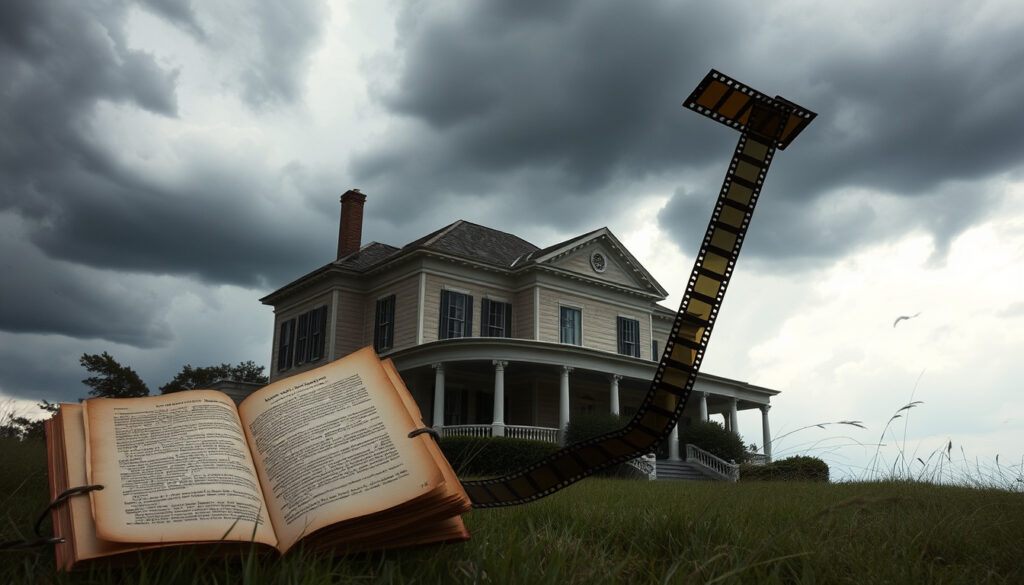
Gone with the Wind: Controversy, Quotes, Box Office & More
Few films have held the public’s attention quite like Gone with the Wind — a sweeping epic that still manages to spark debate more than eight decades after its release. It’s a movie that defined Hollywood’s Golden Age while also raising uncomfortable questions about how the South’s history has been remembered.
Release year: 1939 · Runtime: 238 minutes (original) · Oscars won: 8 (including Best Picture) · Initial budget: 3.9 million USD · Box office (initial release): 390 million USD · Adjusted box office (2024): Over 3.7 billion USD
Quick snapshot
- Release: 1939 (Britannica (encyclopedia reference))
- Director: Victor Fleming (Britannica)
- Runtime: 238 min (original) (Box Office Mojo (box office tracking))
- Budget: $3.9 million (Box Office Mojo)
- 8 Academy Awards (Academy of Motion Picture Arts and Sciences (Oscars official))
- Best Picture, Best Director (Academy)
- Best Actress (Vivien Leigh) (Academy)
- Best Supporting Actress (Hattie McDaniel) (Academy)
- Clark Gable – Rhett Butler (Britannica)
- Vivien Leigh – Scarlett O’Hara (Britannica)
- Olivia de Havilland – Melanie Hamilton (Britannica)
- Hattie McDaniel – Mammy (Britannica)
- AFI #1 Movie Quote (Academy)
- Highest-grossing film (initial run) (Box Office Mojo)
- Controversial depiction of slavery (University of Chicago Humanities (academic research))
- Influence on popular culture (Britannica)
A quick look at the film’s essential statistics reveals a production that was both massive in scale and monumental in achievement.
| Attribute | Details |
|---|---|
| Release date | December 15, 1939 (Britannica) |
| Director | Victor Fleming (with uncredited contributions) (Britannica) |
| Screenplay | Sidney Howard (Britannica) |
| Based on | Novel by Margaret Mitchell (1936) (Britannica) |
| Running time | 238 minutes (intermission included) (Box Office Mojo) |
| Country | United States (Britannica) |
| Language | English (Britannica) |
| Budget | $3.9 million (approx. $85 million today) (Box Office Mojo) |
| Box office | Initial release: $390 million (over $3.7 billion adjusted) (The Numbers (box office analysis)) |
| Academy Awards | 8 wins (including Best Picture) (Academy) |
What is controversial about Gone with the Wind?
Romanticized portrayal of the Antebellum South
- The film has been criticized for its glorification of the Old South and its treatment of African American characters (University of Chicago Humanities).
- The novel uses the N-word frequently; the film script removed it after criticism from the Black newspaper Pittsburgh Courier (ScreenRant (film analysis)).
Racial stereotypes and the legacy of slavery
- Hattie McDaniel won an Oscar but faced segregation at the ceremony (Academy).
- Critics like John Ridley in 2020 called for the film’s removal due to its glorification of the Antebellum South (SAGE Journals (academic analysis)).
For all its technical brilliance, the film’s uncritical embrace of Lost Cause mythology means that watching it today requires a separate conversation about historical accuracy. As University of Chicago Humanities notes, the film romanticizes slavery as benign, a view that modern audiences must actively reckon with.
Modern critical reassessments and censorship debates
- In 2020, HBO Max temporarily removed the film, adding a historical context disclaimer (University of Chicago Humanities).
- The film was compared to Birth of a Nation for propagating white supremacist myths (ScreenRant).
The implication: The film’s legacy is permanently tied to its racial politics. For every viewer impressed by the scale, there is another who finds the nostalgia for a slaveholding society impossible to overlook.
Is Gone with the Wind Irish?
Irish literary influences in Margaret Mitchell’s novel
- Margaret Mitchell was of Irish descent (IrishCentral (Irish diaspora coverage)).
- Mitchell drew Irish literary influence from Thackeray and Dickens, blending with Southern Gothic style (Atlanta History Center (museum research)).
The ‘Big House’ genre and parallels with Irish fiction
- The novel shares themes with the Irish ‘Big House’ genre, such as decline and loss (Irish America Magazine (cultural publication)).
- Critics have drawn parallels between the novel and works like The Last September (Irish America Magazine).
The Irish heritage of Margaret Mitchell, a descendant of an immigrant from Newry, Ireland, adds a layer to the novel that is often overlooked. This connection places Gone with the Wind within a broader tradition of ‘Big House’ literature that mourns a lost aristocratic world — a theme familiar to Irish readers.
Scarlett O’Hara’s Irish heritage and its representation
- The film depicts Scarlett O’Hara’s Irish immigrant father Gerald as embodying the Irish fighting spirit during the Civil War (Irish America Magazine).
- Margaret Mitchell’s great-great-great-grandfather Thomas Mitchell emigrated from Newry, Ireland, in 1792 (IrishCentral).
The pattern: The Irish lens complicates the standard reading of the novel as purely Southern. It joins a global literary tradition of elegies for a passing order, even when that order was built on injustice.
What is the most famous line from Gone with the Wind?
The line: “Frankly, my dear, I don’t give a damn”
- The line is spoken by Rhett Butler in the final scene (Britannica).
- In 2005, the American Film Institute named it the #1 movie quote of all time (Academy).
“Frankly, my dear, I don’t give a damn.”
— Rhett Butler (Clark Gable)
Historical context and censorship issues
- It was considered risqué for 1939 and faced censorship (ScreenRant).
- The line’s defiance reflects the film’s themes of resilience and change (Britannica).
Cultural impact and recognition as a top movie quote
- It remains one of the most quoted lines in cinema history (Academy).
- The line’s enduring popularity underscores the film’s hold on the American imagination.
The trade-off: The shock value of that final line has overshadowed the film’s deeper complexities. For many viewers, it is the only thing they remember — a neat summary of a messy story.
What is the plot of Gone with the Wind?
Setting: Georgia during the Civil War and Reconstruction
- The story follows Scarlett O’Hara’s struggles to maintain her family plantation, Tara (Britannica).
- The Civil War destroys her privileged world, forcing her to adapt (Britannica).
Main characters
- Scarlett O’Hara, Rhett Butler, Ashley Wilkes, Melanie Hamilton (Britannica).
- Her relationship with Rhett Butler is central, culminating in the famous final line (Britannica).
“After all, tomorrow is another day.”
— Scarlett O’Hara (Vivien Leigh)
Key story arcs: love, survival, loss, and transformation
- The novel won the Pulitzer Prize in 1937 (Britannica).
- Scarlett’s transformation from spoiled belle to hardened survivor drives the narrative.
What this means: The plot is a classic rise-and-fall arc wrapped in a historical tragedy. Scarlett’s refusal to give up — “tomorrow is another day” — resonates as both stubbornness and survival instinct.
Who were the main actors in Gone with the Wind?
Clark Gable as Rhett Butler
- Clark Gable was the first choice for Rhett Butler (Britannica).
Vivien Leigh as Scarlett O’Hara
- Vivien Leigh was a relatively unknown British actress when cast (Britannica).
Hattie McDaniel as Mammy
- Hattie McDaniel became the first African American to win an Academy Award (Academy).
Olivia de Havilland as Melanie Hamilton
- Olivia de Havilland was the last surviving cast member before her death in 2020 (Britannica).
Leslie Howard as Ashley Wilkes
- Leslie Howard completed the principal cast (Britannica).
The pattern: The cast was a mix of established stars and fresh faces. McDaniel’s Oscar win was historic, but the racial dynamics on set mirrored the segregation of the era.
How did Gone with the Wind perform at the box office?
Initial release and record-breaking gross
- Upon release, it became the highest-grossing film of all time, a record it held for many years (Box Office Mojo).
- The film’s budget was $3.9 million, making it the most expensive film of its time (Box Office Mojo).
Re-releases and inflation-adjusted earnings
- Adjusted for inflation, it remains one of the top-grossing films in domestic history (over $3.7 billion) (The Numbers).
- Box office success was driven by massive marketing and multiple re-releases (The Numbers).
Comparison to other blockbusters and long-term legacy
- Gone with the Wind is the highest-grossing film ever when adjusted for inflation, surpassing Star Wars and Avatar (Box Office Mojo).
- The Numbers estimates the US box office adjusted for inflation exceeds $4 billion as of 2023 (The Numbers).
The implication: The film’s box office dominance is not just a historical footnote — it remains a benchmark for how massive a single movie can be. Adjusted for inflation, no other film has matched its cultural and financial footprint. For a more recent example of a film that defied expectations at the box office, see our analysis of Joker: Folie à Deux – Worth Watching? Reviews & Flop Analysis.
Confirmed facts
- Vivien Leigh was cast as Scarlett O’Hara after a lengthy search (Britannica).
- Hattie McDaniel was the first African American to win an Oscar (Academy).
- The line “Frankly, my dear, I don’t give a damn” was considered shocking in 1939 (ScreenRant).
What’s unclear
- The exact percentage of Irish ancestry of Margaret Mitchell is not publicly documented (IrishCentral).
- Whether the Irish ‘Big House’ genre directly influenced Mitchell is a matter of scholarly debate, not a confirmed fact (Irish America Magazine).
- The full economic impact of film’s multiple re-releases on adjusted box office totals varies by source (The Numbers).
- How long Gone with the Wind held the record for highest-grossing film depends on whether you count domestic or international and initial run versus re-releases (Box Office Mojo).
“I tried to depict a part of the South that is gone with the wind.”
— Margaret Mitchell (author)
The film’s legacy is a paradox: it is both an artistic triumph and a cultural artifact that forces viewers to confront an uncomfortable past. For American audiences, the film remains a cultural touchstone that demands engagement with its difficult history. For anyone watching today, the choice is clear: watch with eyes open, or let the wind carry the story away uncriticized.
For readers seeking a deeper look into the film’s adaptation and reception, the complete guide to Gone with the Wind provides a thorough breakdown of plot, cast, and enduring controversies.
Frequently asked questions
How long is Gone with the Wind?
The original runtime is 238 minutes, including an intermission. This makes it one of the longest mainstream Hollywood films ever released.
Where can I watch Gone with the Wind?
The film is available for streaming on various platforms, though availability changes. Check services like HBO Max, which has added a contextual introduction, or rent/buy on digital stores.
Why is Gone with the Wind called that?
The title comes from a line in Ernest Dowson’s poem “Cynara”: “I have forgot much, Cynara! gone with the wind.” Mitchell used it to evoke the loss of the Old South.
Is Gone with the Wind based on a true story?
No. The novel and film are works of fiction, though they are set against the historical backdrop of the Civil War and Reconstruction. Many events and characters are invented.
What awards did Gone with the Wind win?
It won 8 Academy Awards at the 1940 ceremony, including Best Picture, Best Director, Best Actress (Vivien Leigh), and Best Supporting Actress (Hattie McDaniel).
How does the book differ from the film?
The film omits many subplots, softens the novel’s brutality, and removes the explicit references to the Ku Klux Klan. The book also contains more details about Scarlett’s children and her later marriages.
Was Margaret Mitchell related to anyone famous?
Not directly, but her great-great-great-grandfather Thomas Mitchell emigrated from Ireland. Some sources note that her family line includes minor historical figures, but no major celebrities.
What is the meaning of the title Gone with the Wind?
The phrase refers to the disappearance of the pre-Civil War Southern way of life, which the novel portrays as irrevocably lost — a world that has literally “gone with the wind.”
More related posts
 Cast of The Conjuring: Last Rites (2025) – Full List & Characters
 How Long Does Poison Ivy Last? Duration & Treatment
 OKC Thunder vs Spurs Player Stats: Game 1 Box Score
 What Is a Condo? Definition, Differences, Pros and Cons
 Gemini AI Photo Prompt: Complete Guide with Templates
 Can Dogs Eat Nuts – Safe Vs Toxic Varieties Guide
 Can Dogs Have Potatoes? Safe Preparation, Risks & Feeding Tips
 AT&T Customer Service Number: Official Support Phone Numbers
