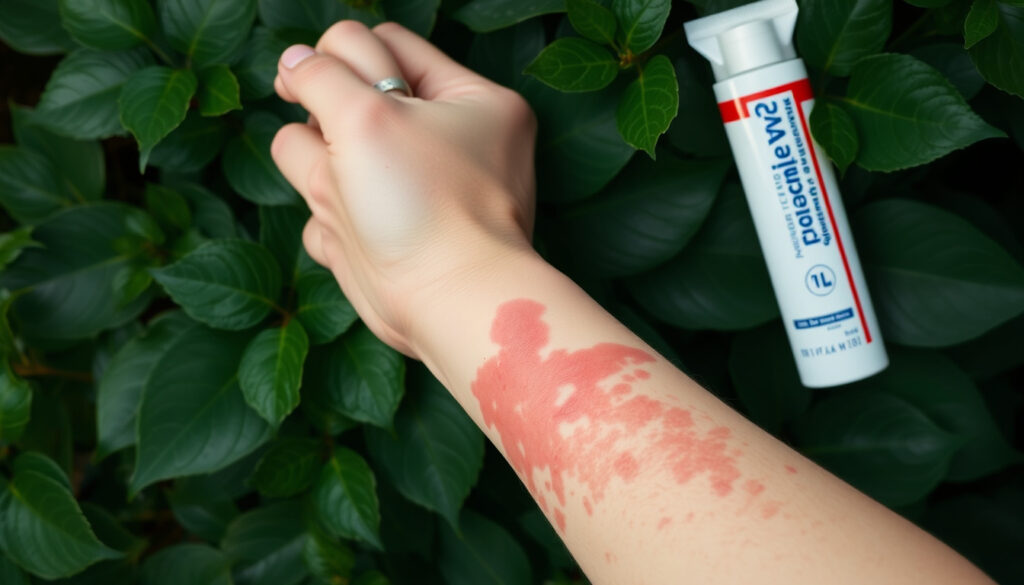
How Long Does Poison Ivy Last? Duration & Treatment
You brushed against a plant in the backyard, and now a patch of itchy red skin is making you wonder how long this will last. It’s a familiar, frustrating scenario for anyone who encounters poison ivy.
Rash onset after contact: 12 to 48 hours ·
Typical duration: 1 to 3 weeks ·
First-time exposure: up to 21 days ·
Repeat exposure (previous rash): 1 to 14 days
Quick snapshot
- Rash lasts 1 to 3 weeks for most people (U.S. FDA consumer health authority)
- Washing skin within 10 minutes of contact reduces severity (Cleveland Clinic academic medical center)
- Blisters contain no urushiol and are not contagious (U.S. FDA consumer health authority)
- Effectiveness of home remedies like toothpaste (Harvard Health academic medical publisher)
- Why some individuals have reactions lasting more than a month (Cleveland Clinic academic medical center)
- Day 1–2: Redness, swelling, itching begins (Harvard Health academic medical publisher)
- Day 3–5: Blisters form and may ooze (Cleveland Clinic academic medical center)
- Day 5–14: Blisters crust over and dry (Harvard Health academic medical publisher)
- Most cases heal completely by week 3 (U.S. FDA consumer health authority)
- Prescription corticosteroids for severe cases (U.S. FDA consumer health authority)
- Urushiol can remain active on clothes for months if unwashed (Cleveland Clinic academic medical center)
Eight key facts define how poison ivy plays out: rash onset, typical duration, what changes for first-time versus repeat exposure, and the role of treatment.
| Fact | Details |
|---|---|
| Rash onset | 12–48 hours after contact (U.S. FDA) |
| Typical duration | 1–3 weeks (Harvard Health) |
| First-time exposure | Up to 21 days (U.S. FDA) |
| Repeat exposure (previous rash) | 1–14 days (Cleveland Clinic) |
| Rash not contagious | Person-to-person spread requires urushiol oil (Harvard Health) |
| Blisters contain no urushiol | Fluid cannot spread rash (U.S. FDA) |
| Washing within 10 minutes | Reduces severity (Cleveland Clinic) |
| Urushiol on surfaces | Active for months on clothes, tools (Cleveland Clinic) |
How long does it take for poison ivy to go away completely?
For most people, the rash runs its course within 1 to 3 weeks. The U.S. FDA consumer health authority states that the rash, blisters, and itching normally disappear in several weeks without treatment. Harvard Health academic medical publisher agrees: a typical bout lasts one to three weeks.
First-time exposure can take up to 21 days, because the immune system takes longer to mount its allergic response. For people who have had a prior rash, the body reacts faster and the rash may clear in 1 to 14 days.
What affects healing time?
- Amount of urushiol exposure: More plant oil on the skin triggers a stronger reaction.
- Individual sensitivity: Some people have a mild response; others develop severe, widespread blisters.
- Timing of washing: The Cleveland Clinic academic medical center recommends rinsing skin with soapy, lukewarm water as soon as possible after exposure—ideally within 10 minutes—to remove urushiol and reduce severity.
How long does poison ivy last on different body parts?
The rash follows the same biological timeline regardless of location, but skin thickness can change the speed. Thin skin on the face, eyelids, or genitals may react more intensely, but healing still falls within the 1-to-3-week window.
A person with poison ivy on their face faces a more severe visible reaction but not necessarily a longer one. The trade-off: more intense symptoms that require careful treatment since face skin is less tolerant of strong topical steroids.
The implication: location influences discomfort and treatment choices, but not the fundamental recovery timeline.
What are the stages of poison ivy rash?
The rash progresses through three distinct stages, according to Harvard Health academic medical publisher.
Stage 1: Redness and swelling
- Begins 12 to 48 hours after contact.
- Itching starts first, then red streaks or patches appear where the plant touched the skin.
- Swelling may develop over the next few hours.
Stage 2: Blisters and oozing
- Blisters form within 1 to 3 days of redness appearing.
- They may ooze clear fluid, but the U.S. FDA consumer health authority states blister fluid does not contain urushiol and cannot spread the rash.
- Blisters can develop over the course of a week before they begin crusting.
Stage 3: Crusting and healing
- Blisters dry out and form a crust, typically 5 to 14 days after onset.
- Itching gradually subsides as the skin heals from the outside in.
- Most cases reach full healing by day 21.
The pattern: the rash moves through inflammation, blistering, then crusting—a cycle that mirrors how the immune system clears the allergen.
What clears up poison ivy the fastest?
Several evidence-backed treatments can reduce symptom severity and shorten the rash’s course.
Over-the-counter treatments
- Calamine lotion dries oozing blisters. The U.S. FDA consumer health authority lists topical skin protectants such as zinc acetate, zinc carbonate, zinc oxide, and calamine as effective for weeping.
- Antihistamines (oral diphenhydramine) reduce itching, though they do not speed healing.
- Hydrocortisone cream (over-the-counter strength) can help mild cases.
- Cool compresses or colloidal oatmeal baths relieve itching. The FDA says baking soda or colloidal oatmeal can relieve minor irritation.
Prescription options
- Prescription-strength topical corticosteroids (e.g., clobetasol) for moderate cases.
- Oral corticosteroids (prednisone) for severe or widespread rashes. The U.S. FDA consumer health authority notes these are effective for severe cases and can significantly shorten the course.
Home remedies to avoid
- Toothpaste: Harvard Health academic medical publisher advises against it—toothpaste can dry the skin but does not address inflammation and may worsen irritation.
- Bleach: Dangerous and can cause chemical burns.
- Rubbing alcohol: Stings and can damage already inflamed skin.
Many home remedies feel temporarily cool or drying but work against the body’s healing process. A person who treats with toothpaste or bleach risks a second chemical reaction on top of the allergic rash—prolonging recovery by days.
The trade-off: safe OTC treatments may not be strong enough for severe cases, while prescription steroids carry their own side effects. The fastest path is early removal of urushiol, then targeted anti-inflammatory treatment.
Can poison ivy spread on sheets?
This is one of the most persistent questions—and the short answer is yes, but not the way people often think.
Does poison ivy stay on bed sheets?
Urushiol, the plant’s oily allergen, can remain active on surfaces for months if not washed. The Cleveland Clinic academic medical center warns that the oil can transfer from sheets to another person, causing a new rash on that person. The rash itself is not contagious, but urushiol on a pillowcase is a vector.
How long does poison ivy last on clothes?
Same issue: urushiol on unwashed clothing stays potent for weeks or even months. The U.S. FDA consumer health authority and Cleveland Clinic academic medical center both recommend washing clothes, sheets, and any fabric that contacted the plant with hot water and detergent as soon as possible after exposure.
A person who sleeps on sheets that contacted poison ivy can develop a new rash days later—not because their own rash spread, but because the oil transferred to clean skin. This is the reason poison ivy sometimes appears to “travel” across the body.
The implication: washing fabric surfaces promptly is as important as washing skin. Failing to do so can extend the period of new rash formation by weeks.
Is poison ivy contagious?
No—but the oil that causes it is. The distinction matters.
How long is poison ivy contagious?
It isn’t contagious at all once the urushiol is removed. The Harvard Health academic medical publisher states plainly: a poison ivy rash is not contagious, even when blisters weep. The Iowa Department of Health and Human Services state health authority confirms that poison ivy is not spread by blister fluid and is not contagious person-to-person unless urushiol oil remains on the skin and is transferred to another person.
Can the rash spread by touching blisters?
No. The clear fluid inside blisters is serum, not urushiol. The U.S. FDA consumer health authority is explicit: blister fluid does not contain urushiol and cannot further spread the rash. The Harvard Health academic medical publisher adds that the rash appears where plant resin touched the skin, not independently across the body.
Poison ivy is simultaneously the most “contagious-looking” rash and one that is scientifically not infectious. The visual drama of blisters makes people fear person-to-person spread, but the only danger is contact with untouched urushiol oil.
Timeline: poison ivy rash from start to finish
Five distinct periods map the typical progression, though individual variation is wide.
- Day 1–2: Redness, swelling, and itching begin at the contact site (Harvard Health).
- Day 3–5: Blisters form; some may ooze clear fluid (Cleveland Clinic).
- Day 5–14: Blisters crust over and dry; itching begins to fade (Harvard Health).
- Day 14–21: Skin heals completely in most cases (U.S. FDA).
- Beyond 21 days: Rare; persistent cases require medical evaluation (Cleveland Clinic).
The pattern: the first week is the most intense, and the second week is the drying and healing phase. Most people are fully clear by the end of week three.
Confirmed vs. unclear facts
Confirmed facts
- Rash lasts 1–3 weeks for most people
- Urushiol causes allergic reaction
- Washing within 10 minutes reduces severity
- Blister fluid does not contain urushiol
- Rash is not contagious
What’s unclear
- Effectiveness of home remedies like toothpaste
- Why some individuals have reactions lasting >1 month
Expert perspectives on poison ivy
“The rash tends to last 1 to 14 days before it clears on its own.”
— American Academy of Dermatology (dermatology professional society)
“Typically, a bout of poison ivy lasts for one to three weeks.”
— Harvard Health Publishing (academic medical publisher)
“Rarely, a skin rash can last for longer than a month.”
— Cleveland Clinic (academic medical center)
For anyone dealing with poison ivy, the choice is clear: wash skin and clothes within 10 minutes of suspected contact, start OTC treatment at the first sign of itching, and skip home remedies like toothpaste. If the rash covers a large area, appears on the face, or shows no improvement in two weeks, medical evaluation is warranted.
health.harvard.edu, doctronic.ai, medriteurgentcare.com, aad.org, ubiehealth.com, hopkinsmedicine.org, dmuclinic.org, healthline.com
While the duration of poison ivy rash varies, understanding the stages can be simplified by reading about common poison ivy myths and treatments.
Frequently asked questions
Can poison ivy rash leave scars?
Scarring is rare. The rash affects the top layer of skin. However, intense scratching can break the skin and introduce bacteria, leading to infections that may scar. Keep nails short and use anti-itch treatments instead of scratching.
Does poison ivy spread through the air?
No. Urushiol is a heavy oil, not airborne. You can only be exposed through direct contact with the plant or contaminated objects. Burning poison ivy plants is dangerous because smoke can carry urushiol particles.
What does the poison ivy plant look like?
The plant has three glossy leaflets per stem, often with reddish edges in spring. The leaves may be green in summer or yellow/orange in fall. “Leaves of three, let it be” is a reliable rule, but the plant can also grow as a climbing vine or ground shrub.
How to prevent poison ivy before exposure?
Wear long sleeves, pants, closed shoes, and gloves when in wooded or overgrown areas. Barrier creams (bentoquatam) can prevent urushiol from absorbing into skin. Learn to identify the plant.
Can pets spread poison ivy to humans?
Yes. Urushiol can cling to a pet’s fur and be transferred to humans who pet them. The pet itself typically does not develop a rash because its fur protects its skin. Wash pets with soapy water if they run through poison ivy.
Does poison ivy get worse with scratching?
Scratching does not spread the rash because blister fluid lacks urushiol. But scratching can damage the skin, introduce bacteria, and cause infection. Use anti-itch treatments to break the scratch cycle.
When should you see a doctor for poison ivy?
See a doctor if: the rash covers a large portion of your body, appears on your face or genitals, has pus or yellow crust (sign of infection), does not improve after 2 weeks, or if you have trouble breathing or swelling of the face (seek emergency care).
More related posts
 Card Shows Near Me: Find Events Today & This Weekend
 Kansas City Chiefs vs Philadelphia Eagles Match Player Stats – Super Bowl LVII & LIX Breakdown
 Geometry Dash Hooda Math: Free Unblocked Rhythm Game
 Motorcycle Dealers Near Me: Top Ireland Shops Dublin Cork
 SAVE Plan Student Loans: How to Transition After Ruling
 How Many People Died on the Titanic? Facts and Figures
 Royal Caribbean Ships by Size: Full Fleet Ranking
