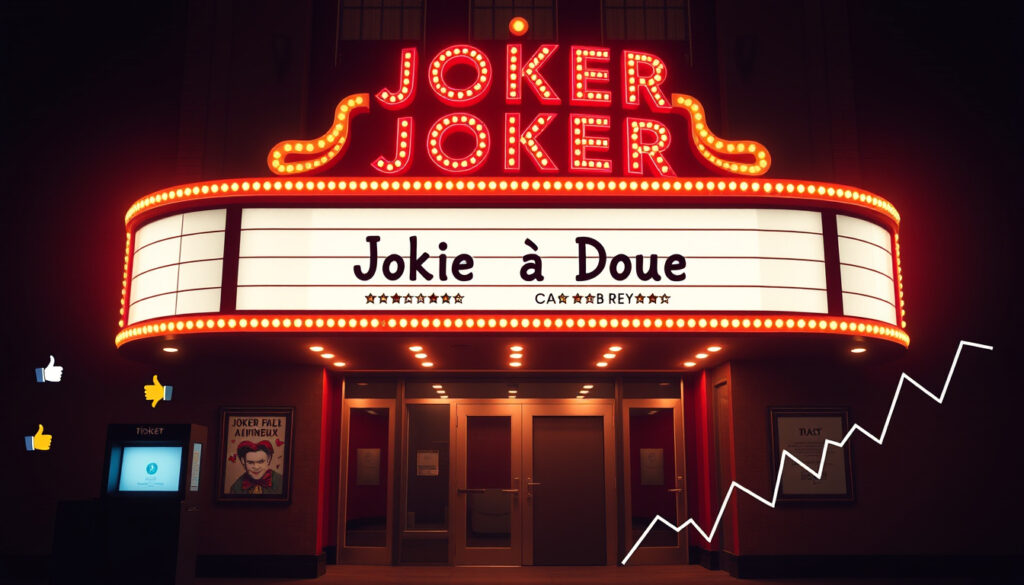
Joker: Folie à Deux: Flop or Hit? Reviews & Box Office
When a movie costs $200 million to make, audiences expect fireworks — not musical numbers. Joker: Folie à Deux, the 2024 sequel to the Oscar-winning Joker, pulled in only $207.5 million worldwide, leaving Warner Bros. with losses estimated at $144–150 million when all costs are tallied.
Starring: Joaquin Phoenix as Arthur Fleck / Joker · Co-starring: Lady Gaga · Sequel to: Joker (2019) · Genre: Crime Musical Drama · Budget: $200 million
Quick snapshot
- $200M budget against $207.5M worldwide gross (Wikipedia)
- Rotten Tomatoes critics score: 31–33% (Premiere)
- CinemaScore of D — lowest ever for a comic book movie (Los Angeles Times)
- Long-term cultural impact remains uncertain
- Specific breakdown of regional box office beyond France and USA/Canada
- Which musical numbers drew the most audience criticism
- Original Joker released 2019, grossed >$1 billion worldwide (Los Angeles Times)
- Venice Film Festival premiere September 2024 (Los Angeles Times)
- Theatrical release October 4, 2024 (Rotten Tomatoes)
The table below consolidates the film’s key specifications alongside verified performance metrics.
| Detail | Value |
|---|---|
| Director | Todd Phillips |
| Lead Actor | Joaquin Phoenix |
| Co-lead | Lady Gaga |
| Premise | Sequel set in Arkham Asylum |
| Runtime | 138 minutes |
| Production Budget | $200 million |
| Marketing Budget | ~$100 million |
| Worldwide Gross | $207.5 million |
| Estimated Loss | $144–150 million |
| Critics Score | 31–33% |
What does Folie à Deux mean Joker?
The title comes from a psychiatric term describing a delusional disorder shared by two people in a close relationship. Folie à deux translates literally to “madness for two” — and in the context of the film, it refers to the relationship between Arthur Fleck (Joker) and his romantic interest, Harley “Lee” Quinzel. Reddit discussions often break down how the phrase captures the film’s central dynamic: two disturbed individuals feeding each other’s delusions. The irony is that director Todd Phillips built the sequel around this shared madness, yet audiences rejected the very concept they once embraced in the first film.
Origin of the term
Folie à deux originated in 19th-century French psychiatric literature, describing a rare condition where a dominant person transmits delusional beliefs to a secondary person. In comic book lore, it refers to the Joker-Harley Quinn relationship — a theme Warner Bros. apparently hoped would salvage the sequel.
Connection to the movie plot
Lady Gaga’s character enters Arthur Fleck’s world as a fellow patient at Arkham Asylum. Their shared musical fantasies create a fantasyland escape — but without the psychological grounding that made the 2019 original work, audiences found the concept hollow rather than compelling.
Is Joker: Folie à Deux a flop?
By any financial measure, yes. The film earned $207.5 million worldwide against a $200 million production budget — before accounting for marketing costs estimated at $100 million. That puts total costs at roughly $300 million, leaving Warner Bros. with losses of $144–150 million when distribution and other expenses are factored in. The Los Angeles Times analysis frames it starkly: a $200 million sequel to a $1 billion original that couldn’t break even. Throw in the $100 million marketing spend, and you have one of 2024’s most spectacular commercial failures.
Box office performance
The opening weekend domestic box office was $40 million — disappointing for a $200M production, and it only got worse. Attendance dropped more than 80% in the second week in the United States, a collapse rate almost unheard of for major releases. The domestic gross ended at $58.3 million, with international markets contributing $149.2 million. To put that in perspective: Terrifier 3, a horror film produced for $2 million, took the number one position at the American box office during the same period.
The implication: even horror micro-budget productions outperformed this $200M blockbuster, underscoring the severity of audience rejection.
Compared to biggest flops
The sequel ranks among the most expensive flops in recent memory — not quite at the level of John Carter ($250M loss) or Solo: A Star Wars Story ($85M loss), but solidly in catastrophic territory. What makes Joker: Folie à Deux unusual is that it wasn’t a spin-off or adaptation — it was a direct sequel to an Oscar-winning film from a director audiences trusted.
Warner Bros. spent $300M+ on a sequel to a $55M film. The original Joker made $1 billion. The sequel made less than its predecessor’s budget — and that’s before marketing.
Why did the Joker Folie à Deux fail?
The film received seven Razzie nominations including Worst Picture, but the awards are symptom, not cause. The failure stems from a fundamental mismatch between what audiences wanted and what Todd Phillips delivered. The original 2019 Joker succeeded on psychological realism and moral ambiguity. The sequel abandoned both in favor of musical numbers that serve little narrative purpose and lack the storytelling power of traditional jukebox musicals, according to the Los Angeles Times review.
Creative choices
Todd Phillips chose to make Joker: Folie à Deux a musical — a decision that baffled fans of the original. Musical sequences in the first film were brief and symbolic; in the sequel, they dominate the runtime. The Tab’s analysis notes the film “failed to execute its self-destructive and meta-critical objective, resulting in a boring viewing experience.” Joaquin Phoenix and Lady Gaga delivered what reviewers called “baffling vocal performances” — their acting chops were never in question, but the material didn’t showcase them.
Audience expectations
The original Joker won two Academy Awards, grossed more than $1 billion worldwide, and sparked genuine cultural debate about mental health and . Fans expected a darker, more sophisticated follow-up. Instead, they got musical numbers and a courtroom drama. The CinemaScore of D reflects fundamental audience dissatisfaction — viewers felt lied to about what kind of film this would be.
What this means: when marketing promises one experience and delivery delivers another, audience trust erodes faster than box office projections.
Budget issues
The $200 million production budget was nearly four times the original’s $55 million. With $100 million in marketing costs, Warner Bros. needed to clear roughly $300 million just to break even. Given the niche appeal of a psychological crime drama, that math was always going to be difficult — especially with a genre shift no one asked for.
Is the new Joker movie good?
Critics and audiences disagreed on whether the film was “good,” but they agreed it wasn’t what they wanted. The Rotten Tomatoes critics score of 31–33% reflects largely negative reviews, with common complaints including repetitive structure and lack of narrative progress. The Guardian review described the film as “claustrophobic and repetitive” — a far cry from the first film’s electric tension.
Critical reception
Critical consensus pointed to wasted potential. The film’s Venice Film Festival competition slot suggested artistic ambitions, but execution fell flat. Reviewers praised individual scenes and performances while condemning the overall structure. The musical format drew particular criticism: sequences felt disconnected from the narrative rather than advancing it.
Audience scores
Audience reaction was swift and brutal. The D CinemaScore was unprecedented for comic book films, indicating viewers genuinely disliked the experience. France recorded 1,042,735 ticket entries — better than the United States, where the film received poor reception. Word-of-mouth killed the film fast: 80%+ attendance drops in week two proved audiences weren’t recommending it.
The catch: both critics and audiences rejected the film, but for different reasons — critics found it poorly executed, while audiences found it simply wrong for them.
When critics and audiences agree a film is bad, the damage is unrecoverable. When they agree it’s simply wrong for them, you have a messaging problem — and messaging couldn’t save Joker: Folie à Deux.
Did Lady Gaga get along with Joaquin Phoenix?
On-screen chemistry between Lady Gaga and Joaquin Phoenix was central to the film’s marketing — and it worked in the sense that their musical duets were among the few sequences critics didn’t universally pan. Reports from the production suggested genuine collaboration: sources described moments where Lady Gaga met Joaquin Phoenix with creative energy that translated to their scenes together. Whether their off-screen relationship was warm or purely professional matters less than whether the film captured the connection.
On-set stories
Both performers brought strong artistic reputations to the project. Lady Gaga, known for her role in A Star Is Born, and Joaquin Phoenix, an Oscar winner for Joker, represented serious talent. The film’s musical elements played to Lady Gaga’s strengths specifically — her vocal abilities outpaced Phoenix’s, creating an uneven dynamic reviewers noticed.
Meeting anecdotes
Production reports indicated Phoenix remained method throughout filming, as he had been for the original. Lady Gaga adapted to his intensity while bringing her own performance style. The result, according to critical consensus, was inconsistent: strong individual moments without sustained chemistry. Both gave the material more than it deserved, but neither could save a fundamentally flawed concept.
Two of Hollywood’s most electric performers couldn’t generate heat on screen. The musical format that should have showcased their chemistry became the format that buried it.
Upsides
- Venice Film Festival competition slot validated artistic ambitions
- Strong individual performances from Phoenix and Gaga
- Some musical sequences showed genuine creativity
- Original film’s core themes of isolation preserved
Downsides
- $144–150M loss for Warner Bros.
- D CinemaScore — lowest for comic book movie
- Musical format alienated original fanbase
- 80%+ attendance drop in week two
The pattern: even the film’s strengths couldn’t overcome the structural mismatch between audience expectations and creative execution.
Timeline
Key milestones in the film’s journey from anticipation to commercial collapse.
| Date | Event |
|---|---|
| 2019 | Original Joker released, grossed >$1 billion worldwide |
| October 2024 | Joker: Folie à Deux premiere at Venice Film Festival |
| October 4, 2024 | Theatrical release |
| October 2024 | Opening weekend: $40 million domestic |
| October 29, 2024 | Streaming (VOD) release — less than four weeks after theatrical |
Confirmed vs. Unclear
Confirmed
- Sequel status and main cast confirmed
- Title translation: “madness for two”
- $200M budget, $207.5M worldwide gross
- Rotten Tomatoes score 31–33%
- 7 Razzie nominations
Unclear
- Final box office totals still being tallied
- Long-term cultural impact uncertain
- Which specific musical sequences drew most criticism
What critics and audiences said
The film’s musical numbers serve little narrative purpose and lack storytelling power compared to traditional jukebox musicals.
— Los Angeles Times review
Claustrophobic and repetitive — a film that abandons the original’s moral complexity for cheap spectacle.
— The Guardian review
Folie à Deux means A madness shared by two — but in this case, the madness was Warner Bros. greenlighting a $200M musical no one wanted.
— Film industry observer analysis
Joker: Folie à Deux — The verdict
Warner Bros. learned an expensive lesson about sequel philosophy: audiences don’t want surprises, they want more of what they loved — only bigger. The original Joker was a $55 million art film that happened to gross $1 billion. The sequel was a $200 million musical that couldn’t reach its own budget. For studios betting on established IP, the message is clear: respect what made the original work, or pay the price at the box office. Todd Phillips’ ambitious gamble ultimately destroyed the formula that made the first film possible, leaving Warner Bros. with a $144–150 million loss that will shape greenlight decisions for years.
Related reading: Joker: Folie à Deux Box Office Flop · Joker: Folie à Deux Reviews and Flop Analysis
Debates mirror ours on whether Joker: Folie à Deux signals a hit-flop breakdown amid scrutiny of Gaga-Phoenix chemistry and early returns.
Frequently asked questions
What is Joker: Folie à Deux about?
The film follows Arthur Fleck (Joaquin Phoenix) in Arkham Asylum, where he develops a relationship with fellow patient Harley “Lee” Quinzel (Lady Gaga). The title refers to “madness shared by two,” a psychiatric term describing shared delusions between close individuals.
Who directed Joker: Folie à Deux?
Todd Phillips directed both the original 2019 Joker and the 2024 sequel. He co-wrote the screenplay with Scott Silver.
What are the reviews for Joker: Folie à Deux?
The film received a 31–33% critics score on Rotten Tomatoes. Audiences gave it a D CinemaScore, the lowest ever for a comic book movie.
Joker: Folie à Deux box office collection?
The film earned $207.5 million worldwide against a $200 million production budget. With $100 million in marketing costs, Warner Bros. lost an estimated $144–150 million.
Is Joker: Folie à Deux worth watching?
Critics disagreed on quality but agreed the film didn’t deliver what audiences expected from a Joker sequel. If you enjoyed the musical format and don’t need psychological realism, you may find merit in the performances.
What is the cast of Joker: Folie à Deux?
Joaquin Phoenix reprised his Oscar-nominated role as Arthur Fleck/Joker. Lady Gaga played Harley “Lee” Quinzel. Supporting cast included various Gotham characters in the asylum setting.
Where to watch Joker: Folie à Deux?
The film was released on streaming (VOD/Max) on October 29, 2024, less than four weeks after theatrical release — an unusually fast transition that reflected its box office struggles.
More related posts
 What is a Parallelogram? Definition, Properties, Types
 Corning Museum of Glass: Hours, Tickets, and Visitor Guide
 Alcohol Delivery Near Me: Safe Options, Rules and Limits (2025)
 What Is an Adverb? Definition, Types, Examples
 How to Clean a Dishwasher the Right Way (Step-by-Step)
 Royal Canin Dog Food: Vet Review & Price Guide for Ireland
 Alaska PFD Payment Schedule 2025: Dates and Amount
 Baltimore Ravens vs Pittsburgh Steelers Stats – Head-to-Head Record, Recent Scores
