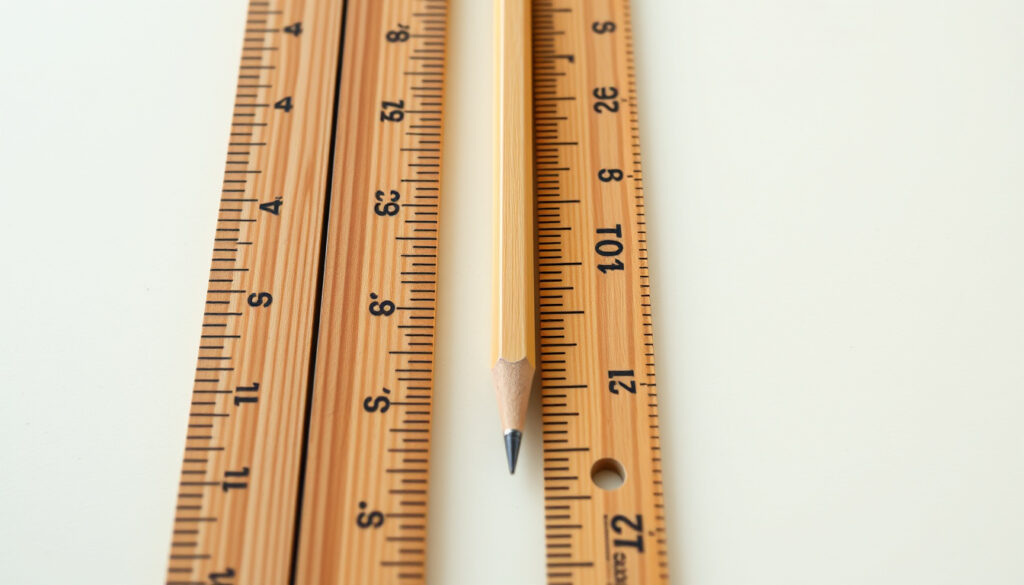
How to Read a Ruler – Inch and Metric Guide
A ruler is one of the most commonly used measuring tools, yet many people struggle to read its markings correctly. Understanding how to interpret the lines on both inch and metric rulers is a fundamental skill applicable across home improvement, crafting, education, and professional fields.
Reading a ruler involves identifying markings on imperial (inch) and metric scales, where imperial uses fractions like 1/16 and 1/32, while metric uses millimeters (mm) within centimeters (cm). Common conversions include 1 inch = 25.4 mm, and accuracy tips emphasize aligning the zero mark precisely, avoiding parallax by viewing straight-on, and double-checking measurements.
How to Read a Ruler in Inches
Inch, Metric, Hybrid
Whole, Half, Quarter, 1/16
1 inch = 25.4 mm
Eye level, firm hold
Understanding Imperial Ruler Markings
Imperial rulers divide each inch into fractions, with line lengths indicating the fraction. The longest lines after inch numbers represent 1/2 inch. The next longest lines mark 1/4 inch, positioned midway between each inch and its half-inch marker. The third longest lines indicate 1/8 inch, sitting between each quarter mark. The shortest common lines represent 1/16 inch, positioned between each eighth-inch marking. Some precision rulers include 1/32 lines for finer resolution.
To read fractions on a ruler, start with the whole inch number before the mark. The fraction comes from how many lines you count from that inch mark. For example, the fourth 1/16 mark after 2 inches equals 2 4/16 inches, which simplifies to 2-1/4 inches. The seventh 1/16 mark after 3 inches equals 3 7/16 inches.
Always reduce fractions to their simplest form when recording measurements. For instance, 12/16 becomes 3/4. Denominators on standard rulers are always powers of 2: 2, 4, 8, or 16. Rulers with 1/32 markings divide each 1/16 into two smaller lines, allowing measurements like 1/32, 3/32, up to 31/32 per inch.
When a fraction exceeds the denominator of the next larger marking, simplify. For example, 12/16 becomes 3/4, and 6/8 becomes 3/4. This makes readings cleaner and easier to communicate.
Key Insights for Inch Ruler Reading
- Imperial rulers use fractional notation based on powers of 2
- Line length corresponds directly to the fraction size
- Longest lines = 1/2, then 1/4, then 1/8, shortest = 1/16
- Always simplify fractions to lowest terms
- Dual-scale rulers have inches on one edge, metric on the other
- Counting from zero ensures accurate readings
| Measurement | Fraction | Millimeters |
|---|---|---|
| 1/2 Inch | 8/16 lines | 12.7 mm |
| 1/4 Inch | 4/16 lines | 6.35 mm |
| 1/8 Inch | 2/16 lines | 3.175 mm |
| 1/16 Inch | 1 line | 1.5875 mm |
How to Read a Metric Ruler
Metric rulers use a decimal system, which many find simpler than fractional imperial measurements. The longest numbered lines mark 1 centimeter (cm), and each centimeter contains 10 millimeters (mm). This base-10 structure means metric conversions involve moving decimal points rather than finding common denominators.
Reading Centimeters and Millimeters
The centimeter lines on a metric ruler are the longest and numbered sequentially. The smaller lines between centimeters represent single millimeters. When reading 1/16 inch on a ruler, imperial users measure by counting lines; metric users instead read the number directly. For example, the third mm line after 5 cm equals 5.3 cm (or 53 mm). The fifth mm line after 4 cm equals 4.5 cm (45 mm).
Metric rulers eliminate the need for fraction reduction. Every marking represents a straightforward decimal value, making calculations faster and reducing reading errors.
Converting Between Systems
Converting between inch and metric requires knowing that 1 inch equals exactly 25.4 mm. To convert fractions, multiply by 25.4: 1/16 inch equals 1.5875 mm, while 1/32 inch equals approximately 0.79375 mm. Many rulers include both systems on opposite edges, allowing quick cross-referencing.
| Fraction | Decimal Inches | mm Equivalent |
|---|---|---|
| 1/16 | 0.0625 | 1.5875 |
| 1/8 | 0.125 | 3.175 |
| 1/4 | 0.25 | 6.35 |
| 1/2 | 0.5 | 12.7 |
The metric system’s decimal basis simplifies conversions significantly. Unlike imperial fractions that require finding common denominators, metric measurements involve moving decimal points. This makes metric particularly useful in scientific and international contexts where standardized measurements matter. For more on metric measurements, visit MathIsFun’s metric length guide.
How to Measure Accurately with a Ruler
Common Mistakes to Avoid
Parallax error occurs when your eye is not directly above the mark, causing readings to shift depending on viewing angle. Always view the ruler perpendicular to your line of sight to eliminate this distortion.
Misaligning the zero mark is another frequent error. The zero line must touch the object’s edge exactly before you begin reading. Starting from the ruler’s end rather than the zero mark introduces systematic error into every measurement.
Failing to reduce fractions leads to cumbersome expressions like 4/16 instead of 1/4. Always simplify readings by dividing both numerator and denominator by their greatest common factor.
Tips for Precision
Confusing line lengths causes many reading errors. Memorize the longest-to-shortest progression: 1/2 > 1/4 > 1/8 > 1/16. This pattern repeats on every inch of the ruler. Use a magnifier for tiny lines when precision matters, and work in bright lighting to maximize visibility.
For measuring tapes, account for hook play. The metal hook at the end has approximately 1/16 inch of play, which means outside measurements read slightly long while inside measurements read slightly short. Double-checking critical work by measuring from the opposite direction catches errors before they compound.
When you need to open containers without specialized tools, similar measurement principles apply. Learning how to open a can without a can opener demonstrates how practical measurement skills transfer across everyday situations. Learning how to open a can without a can opener demonstrates how practical measurement skills transfer across everyday situations, much like learning how to make custard with this helpful guide at how to make custard.
Step-by-Step Measurement Process
- Align the zero — Position the zero mark exactly at the starting edge of the object being measured
- Identify the scale — Determine whether you are reading inches or metric based on your ruler type
- Read the whole number — Note the largest whole increment before your measurement point
- Count the lines — Count fractional or mm lines from the whole number to your endpoint
- Simplify if needed — Reduce fractional inches and convert metric readings as necessary
- Verify the measurement — Double-check by repositioning or measuring from the opposite direction
What Is Standardized and What Varies
Established Information
- Class I ruler accuracy: ±0.5 mm over 300 mm
- Exact conversion: 1 inch = 25.4 mm (since 1959)
- Line hierarchy: 1/2 > 1/4 > 1/8 > 1/16
- Metric structure: 10 mm per centimeter
- ISO tolerance standards for measuring tools
Information That Varies
- Specialty rulers: architect scales use 1/4 inch = 1 foot ratios
- Engineering rulers: some include 1/64 markings
- Material accuracy: plastic versus steel ruler precision
- Manufacturing tolerances: vary by country and standard
The History and Standards Behind Rulers
The measurement standards governing rulers have ancient origins. Early Egyptian rulers around 3000 BCE established length standards based on body proportions, with the cubit derived from the distance between elbow and fingertips. The modern imperial system took shape through centuries of refinement, gaining official definition in the United States through the Mendenhall Order of 1893, which established the relationship between imperial and metric units.
International agreement in 1959 standardized the inch at exactly 25.4 millimeters across all participating nations. The metric system, developed during the French Revolution and refined through the International System of Units (SI), became the worldwide standard for scientific and industrial applications. Organizations like the National Institute of Standards and Technology provide detailed measurement guidance for calibration and proper use.
The National Institute of Standards and Technology serves as the primary authority for measurement standards in the United States, maintaining calibration services and technical guidance for precision instruments.
International standards organizations establish universal guidelines ensuring consistency across manufacturing, education, and scientific communities worldwide.
Summary
Reading a ruler accurately requires understanding both imperial fractions and metric decimals. Imperial rulers display fractions based on powers of 2, from 1/2 down to 1/16 or finer, while metric rulers show clean decimal divisions in millimeters and centimeters. The key to accuracy lies in proper alignment of the zero mark, viewing perpendicular to eliminate parallax, and reducing fractions to their simplest form. Standardization through organizations like NIST and ISO ensures consistent measurements worldwide, though specialty rulers may include additional scales for specific applications. Practice with real objects, whether measuring ingredients for sourdough bread or crafting projects, builds confidence in applying these principles.
Frequently Asked Questions
How many millimeters are in an inch?
One inch equals exactly 25.4 millimeters. This standardized conversion has been in place since 1959.
What are the lines on a ruler called?
The lines represent fractional divisions: longest lines mark 1/2 inches, next longest mark 1/4 inches, followed by 1/8 inches, and shortest common lines mark 1/16 inches. Metric rulers use millimeter lines between numbered centimeter marks.
What is parallax error in ruler reading?
Parallax error occurs when viewing the ruler from an angle rather than directly above, causing the measurement mark to appear shifted relative to the object. This error is eliminated by positioning your eye perpendicular to the ruler face.
How do you read 1/16 on a ruler?
Count 16 equal lines from the zero mark, with each line representing 1/16 of an inch. The fourth line past any inch mark represents 4/16 or 1/4 inch.
What is the difference between inch and metric rulers?
Inch rulers use fractions (1/2, 1/4, 1/8, 1/16) based on powers of 2, while metric rulers use decimal divisions where each centimeter contains 10 millimeters. Imperial measurements require fraction reduction, while metric measurements use straightforward decimal notation.
How do you reduce ruler fractions?
Divide both numerator and denominator by their greatest common factor. For example, 12/16 reduces to 3/4 by dividing both by 4. This makes measurements easier to communicate and compare.
Why should you align the zero mark exactly?
The zero mark represents the true starting point for measurement. Starting from the ruler’s physical edge instead can introduce systematic error since many rulers have a small margin before the zero line begins.
How many lines are between inch marks on a ruler?
A standard 1/16-inch ruler has 16 lines between each inch mark. Precision rulers with 1/32 markings have 32 lines per inch, with two smaller lines between each 1/16 marking.
More related posts
 Naturalization Ceremony ICE Concerns: Cancellations and Rights
 What is a Parallelogram? Definition, Properties, Types
 How Long Does Poison Ivy Last? Duration & Treatment
 How to Clean a Dishwasher the Right Way (Step-by-Step)
 Retail Stores Closing September 2025: Full List & Reasons
 Where Do Bed Bugs Come From – Sources Myths Prevention
 Seychelles Chikungunya Outbreak: Travelers Face High Risk
 Will SNAP Benefits Be Issued in November 2025 – Dates and Status
