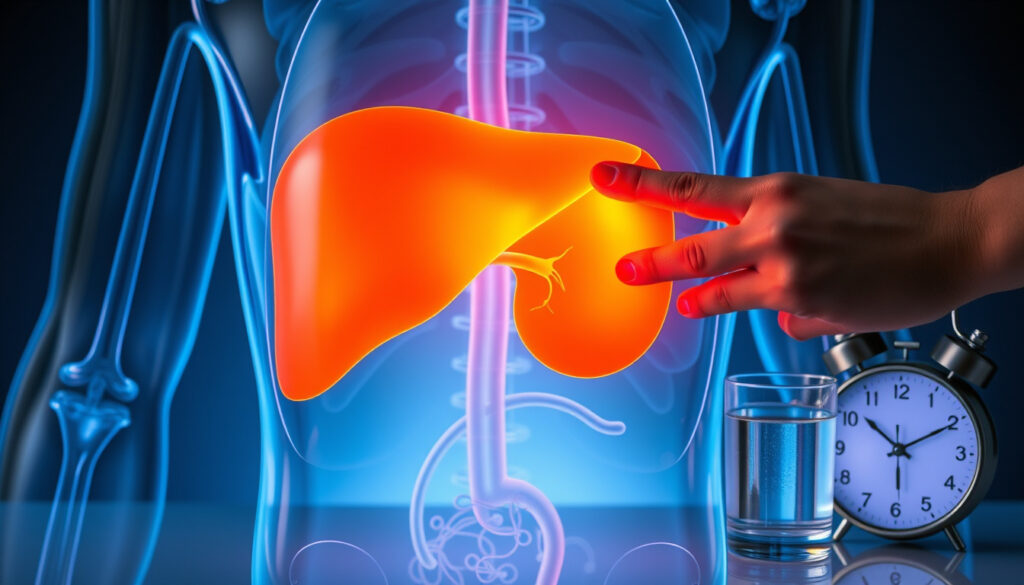
Fatty Liver Symptoms: Early Signs, Pain Location, Relief
You’ve probably felt that vague, persistent tiredness or a dull ache in your upper belly and wondered if it’s just stress. For millions, those subtle signals point to something deeper: fatty liver disease, a condition that often whispers long before it shouts.
Global prevalence: NAFLD affects an estimated 25% of adults worldwide ·
Asymptomatic rate: Many individuals show no symptoms until advanced stages ·
United States prevalence: Approximately 24% of U.S. adults have fatty liver disease ·
Risk of progression: Up to 20% of NAFLD patients develop NASH (non-alcoholic steatohepatitis)
Quick snapshot
- Fatigue and general malaise (NHS (UK health authority))
- Right upper abdominal pain or fullness (Mayo Clinic (leading U.S. medical center))
- Unexplained weight gain or loss (Healthdirect Australia (Australian government health service))
- Mild jaundice (late stage) (Bradford Hospitals NHS Foundation Trust (UK hospital trust))
- Brain fog and difficulty concentrating (British Liver Trust (UK liver charity))
- Dark skin patches (acanthosis nigricans) (Cleveland Clinic (U.S. academic medical center))
- Itchy skin without rash (Mayo Clinic)
- Bloating after meals (Cleveland Clinic)
- Persistent fatigue lasting weeks (NHS)
- Swelling in legs or abdomen (Mayo Clinic)
- Yellowing of skin or eyes (Bradford Hospitals NHS Foundation Trust)
- Vomiting blood or black stools (British Liver Trust)
- Adopt Mediterranean-style diet (Mayo Clinic (treatment guidelines))
- Exercise at least 150 minutes per week (NHS)
- Limit added sugars and refined carbs (Healthdirect Australia)
- Achieve 7-10% weight loss if overweight (British Liver Trust)
Four key figures on the disease’s reach and trajectory show why early detection matters.
| Label | Value |
|---|---|
| Prevalence | ~25% of global adult population (Mayo Clinic) |
| Typical onset | Often develops in 40s-60s, increasing with obesity and diabetes (NHS) |
| Risk factors | Obesity, type 2 diabetes, high cholesterol, high triglycerides, metabolic syndrome (Healthdirect Australia) |
| Progression rate | About 20% of simple steatosis cases progress to NASH over 7-10 years (British Liver Trust) |
Most people with fatty liver disease carry it silently for years. The window for reversal is wide open in stage 1, but narrows with each tick of inflammation.
What are the symptoms of a fatty liver?
What are the first signs of a bad liver?
- Fatigue — The NHS (UK health authority) lists feeling very tired as a common symptom of NAFLD.
- Upper right abdominal discomfort — A dull or aching pain in the top right of the tummy, over the lower right side of the ribs, per NHS 111 Wales (Welsh health service).
- Feeling generally unwell — Vague malaise is reported by many patients, notes the NHS.
- Loss of appetite and nausea — Bradford Hospitals NHS Foundation Trust (UK hospital trust) lists decreased appetite and nausea as possible MASLD symptoms.
What are 5 signs of a fatty liver?
- Fatigue or extreme exhaustion — Cleveland Clinic (U.S. academic medical center) highlights weakness as a key symptom.
- Abdominal pain (right upper quadrant) — Confirmed by Mayo Clinic (leading U.S. medical center).
- Itchy skin — Can signal progression to MASH or cirrhosis, according to Mayo Clinic.
- Swollen belly or legs — Ascites and edema indicate advanced disease, per Bradford Hospitals NHS Foundation Trust.
- Jaundice (yellow skin/eyes) — A late-stage marker of liver dysfunction, notes Bradford Hospitals NHS Foundation Trust.
The most deceptive symptom is fatigue: it’s easy to blame on sleep or stress, but when it lingers for weeks alongside a dull right-side ache, the liver should be on your radar.
The implication: early-stage fatty liver can be nearly invisible. That’s why proactive monitoring matters more than waiting for pain to strike.
Where is the pain with a fatty liver?
Fatty liver pain has a very specific address: the upper right side of your abdomen, just below the ribs. Mayo Clinic describes it as discomfort in the upper right belly area. The NHS 111 Wales defines it as a dull or aching pain over the lower right side of the ribs.
The British Liver Trust (UK liver charity) adds that discomfort may be felt on the upper right side of the tummy where the liver sits. Because the liver can enlarge considerably before you notice, the pain is often described as fullness, pressure, or a vague ache — easily dismissed as gas or indigestion.
In advanced stages, Cleveland Clinic notes the pain can radiate to the right shoulder or back as the liver pushes against surrounding structures. The trade-off: early liver pain is subtle, making it easy to ignore until the underlying inflammation has set in.
What is the first stage of fatty liver disease?
Fatty liver disease follows a four-stage path, each with a different prognosis. The British Liver Trust outlines:
- Stage 1 – Simple steatosis: Fat accumulates in liver cells with no inflammation. Usually no symptoms. Fully reversible with lifestyle changes.
- Stage 2 – NASH (steatohepatitis): Fat plus inflammation. Fatigue and mild discomfort may appear. Risk of fibrosis begins.
- Stage 3 – Fibrosis: Scar tissue starts replacing healthy liver. Symptoms become more noticeable.
- Stage 4 – Cirrhosis: Extensive scarring impairs liver function. Jaundice, ascites, varices, and risk of liver failure. The Mayo Clinic warns that once cirrhosis develops, the damage is largely irreversible.
The catch: most people are diagnosed in stage 3 or 4, simply because earlier stages cause no alarm. Knowing the stage progression gives you a roadmap for when to push harder for answers.
What foods are good for fatty liver?
What drink cleans the liver?
Diet is the most powerful lever for reversing early fatty liver. The Mayo Clinic (treatment guidelines) recommends a Mediterranean-style diet rich in fruits, vegetables, whole grains, lean proteins, and healthy fats like olive oil. Specific foods with evidence: coffee, green tea, leafy greens, fatty fish, nuts, and avocado.
What drinks help? NHS and the British Liver Trust both point to coffee (both caffeinated and decaf) as linked to lower liver enzyme levels and reduced fibrosis. Green tea is also associated with improved liver fat markers. Water, naturally, is the base.
What to avoid: high-fructose corn syrup, sugary drinks, refined carbs, and saturated fats. The Healthdirect Australia (Australian government health service) stresses that even moderate weight loss of 7-10% can significantly reduce liver fat.
No single drink can “clean” your liver. The evidence supports consistent dietary patterns — not a magic detox — as the path to reducing liver fat.
The implication: consistency in diet matters more than any quick fix.
How to check liver function at home?
What is the quickest way to reduce a fatty liver?
While a formal diagnosis requires a doctor, you can monitor your body for warning signs at home. NHS suggests watching for: persistent fatigue, swelling in legs or abdomen, easy bruising, dark urine, pale or bloody stool, and yellowing of skin or eyes.
Home test kits for liver enzymes (ALT and AST) are available over-the-counter. However, the Mayo Clinic stresses they are not a substitute for professional evaluation — a single elevated reading doesn’t confirm fatty liver, and normal results don’t rule it out.
The quickest way to reduce a fatty liver, per the British Liver Trust:
- Lose 7-10% of body weight if overweight
- Exercise at least 150 minutes weekly (brisk walking counts)
- Eliminate sugary drinks and limit alcohol
- Switch to a Mediterranean diet
- Control blood sugar and cholesterol with your doctor
The pattern: diet and exercise are the fastest levers, but medical oversight ensures you’re on the right track.
Timeline signal
Fat accumulation in liver cells; usually no symptoms; reversible with lifestyle changes. Source: British Liver Trust
Inflammation added; fatigue and mild discomfort may appear; risk of fibrosis starts. Source: Mayo Clinic
Scar tissue replaces healthy liver; symptoms become more noticeable. Source: NHS
Extensive scarring impairs liver function; jaundice, ascites, varices appear; risk of liver failure. Source: Mayo Clinic
Clarity check
Confirmed facts
- Obesity and insulin resistance are primary drivers of NAFLD (Mayo Clinic)
- Weight loss and diet can reverse early-stage fatty liver (NHS)
- Elevated liver enzymes (ALT/AST) indicate liver stress (Mayo Clinic)
What’s unclear
- Effectiveness of specific herbal supplements (e.g., milk thistle) is not proven in large trials (NCCIH (U.S. federal research agency))
- Role of microbiome manipulation in direct reversal is still being studied (British Liver Trust)
- Exact mechanisms of why some people with steatosis progress to NASH while others do not (Mayo Clinic)
Expert perspectives
Many people with NAFLD have no symptoms, or their symptoms are so mild that they go unnoticed.
— NHS (UK health authority)
Nonalcoholic fatty liver disease usually doesn’t cause signs and symptoms. When it does, they may include fatigue and pain or discomfort in the upper right belly area.
— Mayo Clinic (leading U.S. medical center)
If left untreated, NAFLD can progress to more serious liver conditions, including cirrhosis and liver failure.
— American Liver Foundation (U.S. patient advocacy organization)
For the estimated one in four American adults with fatty liver disease, the choice is clear: take symptoms like persistent fatigue and right-side discomfort seriously, or risk progressing through stages that become increasingly irreversible. A Mediterranean diet, 150 minutes of weekly exercise, and 7-10% weight loss are your best bets for turning the tide — but only if you start before the fibrosis sets in.
mayoclinichealthsystem.org, tgh.org, mcpress.mayoclinic.org, youtube.com, mayoclinic.org
Frequently asked questions
Is fatty liver disease dangerous?
Yes, if left untreated it can progress to NASH, cirrhosis, and liver failure. Early-stage fatty liver is reversible, but advanced stages carry serious risks. (Mayo Clinic)
Can fatty liver cause death?
Indirectly, yes. Cirrhosis from fatty liver disease can lead to liver failure and increase the risk of liver cancer. However, the majority of people with simple steatosis do not die from liver-related causes. (NHS)
What are the symptoms of fatty liver in females?
Symptoms are similar to males: fatigue, right upper abdominal discomfort, and itching. Research also suggests women may experience more pronounced brain fog and hormonal changes, though large-scale sex-specific studies are limited. (British Liver Trust)
What are the symptoms of fatty liver in males?
Men commonly report fatigue, dull abdominal pain, and reduced libido (due to hormone imbalances from liver dysfunction). Male pattern baldness and gynecomastia (breast tissue growth) can appear in advanced disease. (Mayo Clinic)
Does fatty liver cause back pain?
Rarely. In advanced cases, an enlarged liver can press on surrounding structures, causing referred pain to the right shoulder or mid-back. However, typical fatty liver pain is in the upper right abdomen, not the back. (Cleveland Clinic)
Can you feel a fatty liver when you press on your abdomen?
Sometimes. If the liver is significantly enlarged (hepatomegaly), a doctor can feel it below the right rib cage during a physical exam. At home, you may notice a sense of fullness or pressure in that area. (NHS)
What is the life expectancy with fatty liver disease?
For stage 1 (simple steatosis), life expectancy is normal with lifestyle changes. For NASH with fibrosis, life expectancy can be reduced by 5-10 years if untreated. Cirrhosis carries a 10-year survival rate of about 50% without a transplant. (British Liver Trust)
More related posts
 Necessary and Proper Clause: Definition, Examples, Key Case
 How to Factory Reset a MacBook: Intel & Apple Silicon
 How to Enter Your Microsoft Link Code: Complete Guide
 Naturalization Ceremony ICE Concerns: Cancellations and Rights
 As It Was Lyrics: Meaning, Writing, and All Your Questions Answered
 Medal Count Olympics 2026 – Norway Tops Table with Record 41 Medals
 Charlie Kirk Wife and Kids – Erika Frantzve and Family Details
 The Haunting in Connecticut – True Story Behind the Movie
